THE LONG READ
A printer, scientist and negotiator turned personal credibility into recognition, credit, supplies and a place for the United States in world commerce.
The diplomat at work
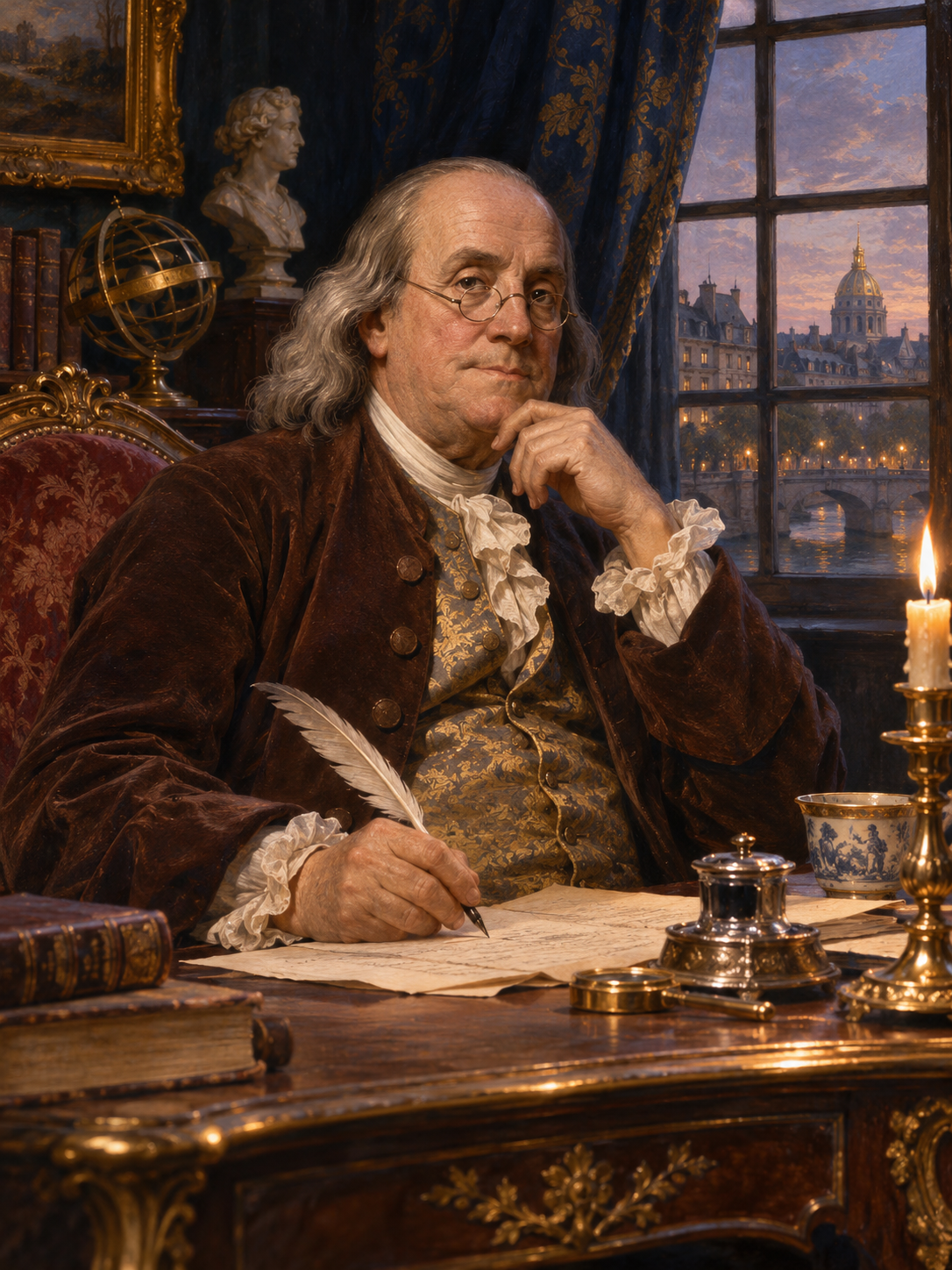
In March 1782, Benjamin Franklin was at his house in Passy, outside Paris, trying to keep American bills from going unpaid. The war for independence was still being fought, the United States had little fiscal capacity, and the French government was under strain. Franklin pressed for fresh support; France promised six million livres, paid in installments. In a letter to Robert Morris, Congress's superintendent of finance, he explained what the money could cover: bills of exchange, obligations to suppliers, and other American commitments. The correspondence strips away the familiar portrait of Franklin as merely a charming guest in Paris. He was maintaining a fragile country's credit while asking an ally to keep investing in its future. Franklin to Robert Morris, March 4, 1782; Office of the Historian on revolutionary loans.
That is why he belongs in a history of American commercial diplomacy. The phrase is a modern lens, not an office he held or a term he used to describe an eighteenth-century program. In Franklin's career, however, recognition, trade, finance, supply chains, reputation and political alliance were inseparable. A treaty that opened ports mattered to an army that needed supplies; a banker who trusted American bills mattered to a new government; a foreign minister who believed in the republic mattered to its survival.
Before Paris, a long apprenticeship in London
Franklin did not arrive in France as an inexperienced celebrity. He had spent years representing Pennsylvania and other colonial interests in London. His printing business and scientific reputation had already taught him how information traveled and how credibility was built. In 1766 he testified before Parliament during the controversy over the Stamp Act. His position had changed: he had initially supported the tax, then opposed it after he saw the depth of colonial resistance. That development matters more than a tidy origin story. Franklin had tried to preserve an imperial relationship before becoming an advocate of a separate American one. Library of Congress, Franklin and the Stamp Act; Library of Congress, Franklin Papers.
By 1776, independence created a hard international problem. A declaration could announce the colonies' intentions, but it could not, by itself, arm soldiers, finance a war or persuade European governments to receive American representatives. The Continental Congress drafted a Model Treaty that emphasized reciprocal commercial relations rather than a binding military alliance. John Adams played a major role in drafting that proposal. Congress sent commissioners to seek French support, including Franklin, Silas Deane and Arthur Lee. Deane had already worked to obtain informal aid; Franklin joined an ongoing effort rather than inventing it alone. Office of the Historian, Model Treaty; Office of the Historian, Continental Congress.
The public face and the private work
Franklin arrived in France late in 1776. His fame as an experimenter and writer made him unusually recognizable. French elites embraced his image as a plainspoken American, an image he understood how to cultivate. His home in Passy became a center of American diplomacy. But personal popularity did not settle the question of alliance. French foreign minister Charles Gravier, comte de Vergennes, weighed France's rivalry with Britain, negotiations with Spain and the uncertain military prospects of the Americans. France had already supplied clandestine assistance through commercial channels, much of it associated with Deane. Vergennes hesitated to make a formal commitment until news of the American victory at Saratoga reached France in December 1777. Office of the Historian, French Alliance; Office of the Historian, Franklin.
Franklin's achievement was partly relational: he made the United States legible and credible to the people whose decisions could help it survive. The French decision was also strategic and collective. It should not be reduced to one man's charisma. Vergennes, Deane, Lee, the Continental Congress, French lenders and military leaders, and the American victory at Saratoga all belong in the story.
Two treaties, one turning point
On February 6, 1778, Franklin, Deane and Lee signed two agreements with France. The Treaty of Amity and Commerce recognized the United States and established reciprocal trading privileges. It addressed the treatment of merchants, ships, ports and consuls. Its terms grew out of the Model Treaty Congress had approved in 1776, although the final bargain provided most-favored-nation privileges rather than the broader commercial opening some Americans had first contemplated. The companion Treaty of Alliance linked France and the United States militarily against Britain and constrained either partner from making a separate peace without the other's consent. Office of the Historian, Model Treaty; National Archives, Treaty of Alliance; 1778 Treaty of Amity and Commerce text, U.S. Statutes at Large.
The commercial agreement did more than promise future sales. It told French merchants and officials that there was a new country with which to conduct legitimate business. The alliance did more than provide a diplomatic photograph: it attached French power and resources to American independence. Trade and security were designed together. In the treaty's own language, the allied objective included sovereignty in both government and commerce. This is an early example of the magazine's central proposition: international opportunity often rests on a relationship strong enough to carry political, financial and practical commitments at the same time.
France's participation helped turn the American Revolution into a wider conflict. It furnished money, materiel, troops and naval power, while Spain and the Netherlands also played consequential roles in the international struggle. It would be misleading to say that Franklin single-handedly won the war. It is fair to say that his work helped bring together the relationships on which military and economic survival depended. National Archives, French alliance; National Archives, Treaty of Paris context.
The everyday economy of an alliance
Franklin was appointed minister plenipotentiary to France in September 1778 and presented his credentials on March 23, 1779, becoming the first American minister formally received by a foreign government. The title gave a recognizable diplomatic form to work already underway. As minister, he had to tend the alliance, represent Congress, answer requests and secure continued support. He could not assume that the French treasury was inexhaustible or that American promises would automatically be trusted. Office of the Historian, appointment record; Office of the Historian, France relations.
The 1782 exchange with Robert Morris shows how closely diplomacy and finance were joined. Franklin negotiated for aid while American obligations flowed across the Atlantic in the form of bills. He worried about their payment and about the country's reputation if they failed. A shipment required a convoy. A loan required a government willing to make it. A promise to a supplier required a bank willing to honor it. The glamorous rooms of Versailles and the prosaic ledgers of Paris were parts of the same mission. Franklin to Robert Morris, March 4, 1782; Franklin to Morris, April 8, 1782.
Peace required another negotiation
As Britain became willing to negotiate, Franklin worked with John Adams and John Jay. Their preliminary articles of November 30, 1782 and the definitive Treaty of Paris of September 3, 1783 established British recognition of American independence. The settlement addressed boundaries, debts and fishing rights, matters that would shape the new country's economic life. The negotiations also tested the French relationship. American commissioners pursued terms with Britain that worried Vergennes; Franklin informed him and sought additional French credit. Vergennes objected to the process but granted further assistance. This was an alliance with friction, sustained through practical bargaining, not a frictionless friendship. Office of the Historian, Treaty of Paris; Office of the Historian, French Alliance; National Archives, Treaty of Paris.
The peace opened a future for the United States, but its territorial promises also had profound consequences for Native nations whose sovereignty and land interests the negotiators did not represent. The treaty's language and American expansion should be read with that absence in view. Likewise, the republic's claim to liberty coexisted with slavery. Franklin had himself enslaved people earlier in life. By his later years he supported abolition, presided over the Pennsylvania Society for Promoting the Abolition of Slavery and signed a petition to Congress in 1790. His change deserves notice; it does not erase the earlier contradiction or the people harmed by it. National Archives, Treaty of Paris text; Library of Congress, Franklin and abolition; Library of Congress, 1790 petition guide.
A wider circle of trade
Franklin's work was not confined to France. While remaining resident in Paris, he negotiated a Treaty of Amity and Commerce with Sweden, signed April 3, 1783. Sweden's recognition and the agreement showed how one relationship could help create another. A war for survival was becoming an effort to establish a durable network of diplomatic and commercial partners. Franklin returned to the United States in 1785; Thomas Jefferson succeeded him in Paris. Office of the Historian, Sweden relations; Office of the Historian, Franklin appointment record.
Franklin's importance to U.S. Commercial Diplomat is not that he performed every task himself, nor that eighteenth-century treaties are a simple blueprint for modern business. It is that he made international work human and operational at once. He listened to an ally's interests, cultivated trust, marshaled evidence of American capacity, protected credit and connected agreements to the daily realities of ships, supplies and money. His life illustrates how a person can help a nation enter the world—and why every account of that achievement must also ask whose interests were served, and whose were left outside the room.
Sources & further reading
The atlas takes its 19-part chronology from the U.S. State Department Office of the Historian’s Milestones series. That series is retired and no longer maintained. The following linked historical records and institutional sources add context to this original editorial account.
- Franklin to Robert Morris, March 4, 1782
- Office of the Historian on revolutionary loans
- Library of Congress, Franklin and the Stamp Act
- Library of Congress, Franklin Papers
- Office of the Historian, Model Treaty
- Office of the Historian, Continental Congress
- Office of the Historian, French Alliance
- Office of the Historian, Franklin
- National Archives, Treaty of Alliance
- 1778 Treaty of Amity and Commerce text, U.S. Statutes at Large
- National Archives, French alliance
- National Archives, Treaty of Paris context
- Office of the Historian, appointment record
- Office of the Historian, France relations
- Franklin to Morris, April 8, 1782
- Office of the Historian, Treaty of Paris
- National Archives, Treaty of Paris text
- Library of Congress, Franklin and abolition
- Library of Congress, 1790 petition guide
- Office of the Historian, Sweden relations