THE LONG READ
From the Commerce Department to a final mission in the Balkans, Ronald H. Brown made a forceful case that American economic leadership depended on people willing to build opportunity across borders.
The person behind the portfolio
At a congressional hearing in January 1995, Ronald H. Brown spoke about what it would take for Americans to prosper in a changing global economy. He connected investment, education, access to markets and innovation. He also insisted that the government had a job to do for companies of every size: help them recognize and pursue export opportunities. The argument came from a Secretary of Commerce who saw the agency as a meeting place for domestic capacity and international possibility.
Brown served as secretary from January 22, 1993, until April 3, 1996. He was the first African American to hold the office. His arrival was significant beyond that distinction. A lawyer, negotiator and former Democratic National Committee chairman, he had built a career bringing people across institutions into working relationships. The Commerce Department's account of its secretaries calls him a pragmatic bridge builder. In a cabinet position often associated with statistics, regulation and industrial policy, Brown made human connection a visible instrument of economic leadership.
A broader idea of commerce
President Bill Clinton later described why Brown's role mattered to the administration's economic design. The White House wanted Commerce and the U.S. trade representative more fully involved in its daily economic decisions, alongside other departments in the National Economic Council. Clinton remembered Brown as someone who accepted the department's larger role and persuaded others to see its potential. The point was institutional as well as personal: exports and foreign investment were becoming central to the administration's understanding of prosperity at home.
Brown's own 1995 testimony made the connection explicit. He said access to foreign markets was a priority, but a legal opening alone would not ensure that American companies could use it. The Trade Promotion Coordinating Committee, which he chaired, had issued a National Export Strategy in 1993 and refined it in 1994. The strategy was meant for small, medium and large firms. Brown named government advocacy on foreign procurement, trade missions and other practical support as ways to move beyond an agreement on paper toward a business opportunity in the field.
Commercial diplomacy in practice
Brown led trade missions across five continents. The Department of Commerce later credited those missions with more than $80 billion in foreign deals for American businesses. That is the department's retrospective account of deals associated with the missions, rather than a measure of the secretary's sole contribution or a count of jobs already realized. The missions nevertheless capture his method. A cabinet officer could convene company leaders, foreign officials and American representatives at a scale that few individual firms could manage by themselves.
In a later Commerce Department remembrance, former Secretary Gary Locke said Brown championed commercial diplomacy: the idea that trade ties could matter alongside political and military ties. Brown's language and actions reflected the post-Cold War moment, when changing markets in Europe, Asia, Latin America, the Middle East and Africa prompted new questions about who could participate. Brown supported open markets and exports, but the story was not simply one of sales. The department recalled him as an advocate for fair arrangements that would help American workers, too. His testimony also focused on education, technology and the Manufacturing Extension Partnership, which served smaller manufacturers. Domestic preparation and foreign access belonged in the same conversation.
Opportunity across the Atlantic
Africa occupied a special place in Brown's vision. In 1998, dedicating a commercial center in Brown's name in Johannesburg, Clinton said Brown had urged an African trip even before Clinton became president and had visited the continent five times. Brown had looked to a changing South Africa and to relationships with African entrepreneurs and business leaders. The Johannesburg center was designed to help American companies enter or expand in sub-Saharan markets, while offering information and points of contact for U.S. and African businesses.
Clinton's dedication also stressed a limit to what American involvement could accomplish alone: African political and business leaders would have to shape their own futures. That distinction matters for a people-centered commercial diplomacy. A market is never merely a destination on a map. It is a set of communities with priorities, institutions and people whose choices cannot be reduced to a foreign company's sales strategy. Brown's interest in trade and investment was paired, in the memorial account, with the hope that prosperity and freedom could reinforce each other.
The final mission and its cost
In April 1996, Brown traveled with a delegation to the Balkans. The mission sought business involvement in economic recovery after war. On April 3, their aircraft crashed in Croatia, killing Brown and 34 others, including Commerce Department employees, business participants and other members of the mission. The loss belongs to all those families and institutions; Brown's public stature should not eclipse the lives of the people traveling alongside him.
Clinton later recalled a conversation shortly before Brown left for Bosnia. He remembered Brown as proud to bring American businesspeople into a region where reconstruction and peace were at stake. The president described a belief that business could help people across divisions and build something useful after violence. It is a powerful account of intention, though the proposed work of a mission must be distinguished from outcomes that its participants did not live to see.
A legacy that remained personal
The Commerce Department continued to remember Brown for export promotion, the workers and firms he wanted to support, and the people he made visible within the institution. A 1996 consumer handbook dedicated to him noted both his foreign trade missions and his attention to employees, service and consumer advocacy. In 1998, Clinton inaugurated the Ron Brown Commercial Center in Johannesburg; the center carried his name into a practical place where businesses could seek information and meet partners. Memorials do not measure an entire career, but they show the many roles colleagues saw in him: organizer, advocate, public servant and mentor.
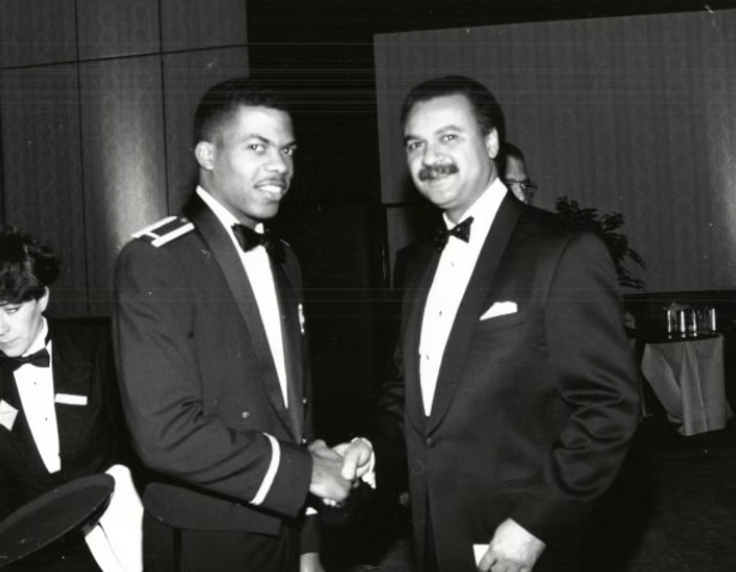
For Christopher C. Herring, publisher of U.S. Commercial Diplomat, that legacy is also a personal memory. Herring recalls serving in protocol for Brown at an event in California and discussing whether to leave the U.S. Air Force for a business position. Herring says Brown urged him to continue his service, develop a business and remain active in chambers of commerce. The event's exact date and setting have not been independently confirmed, so the conversation is presented as Herring's recollection rather than as an archival fact. His fuller reflection belongs in the magazine's founding-voice story.
Brown's record makes a compelling case for studying the person behind commercial diplomacy. Government can negotiate treaties and open doors; a secretary can convene a delegation; a local chamber can connect a business owner to a counterpart abroad. What happens next depends on the people who prepare, listen, take risks and continue the relationship after the formal meeting is over. Brown treated those relationships as consequential. His career asks how a public leader can help more people take part in global opportunity, and how that promise can be made real for workers and communities on both sides of a border.
Sources & further reading
The atlas takes its 19-part chronology from the U.S. State Department Office of the Historian’s Milestones series. That series is retired and no longer maintained. The following linked historical records and institutional sources add context to this original editorial account.
- U.S. Department of Commerce: Secretaries of Commerce
- Ronald H. Brown's 1995 testimony on science, technology and markets
- Commerce Department remembrance of Ronald H. Brown
- Commerce Department recognition ceremony on commercial diplomacy
- President Clinton at the Ronald H. Brown portrait unveiling
- President Clinton at the opening of the Ron Brown Commercial Center
- White House background on the Johannesburg Ron Brown Commercial Center
- Christopher C. Herring's founding-voice reflection