JANUARY 20, 2025 — PRESENT · UPDATED NOVEMBER 26, 2026
What can be said while policy moves?
The January 2025 America First Trade Policy memorandum ordered reviews of deficits, existing agreements, potential bilateral deals and the coming USMCA review. The administration framed tariffs as leverage for market access and domestic investment. Counterpart governments, Congress, courts, companies and consumers have shaped what the policy can do. A headline deal may be a framework, a signed instrument, or an operative rule; the distinctions matter while the term is still underway.
The White House imposed reciprocal tariffs in April 2025 using emergency authority. In Learning Resources v. Trump on February 20, 2026, the Supreme Court held that IEEPA does not authorize presidential tariffs. This ruling concerned that statute; it did not decide every other tariff authority. USTR’s tariff-action record identifies subsequent actions under other laws. Readers should not assume a 2025 rate still applies unchanged in November 2026.
THE PEOPLE AND THE MACHINERY
Institutions make policy real.
USTR Jamieson Greer, Commerce Secretary Howard Lutnick, State, Treasury, Customs and Border Protection, the International Trade Administration’s Advocacy Center and overseas commercial officers occupy different roles. Commerce reported in October 2026 that its advocacy supported 216 signed contracts worth more than $383 billion since January 2025, with stated U.S. export content and jobs supported. These are Commerce’s attributed figures using its own methodology, not an independent causal audit of jobs or delivery. Foreign buyers, U.S. firms and workers determine how contracts turn into production and pay. A July 2025 AI export order tasked Commerce, State and other agencies with developing American technology export packages. In July 2026 testimony, State Assistant Secretary Caleb Orr described a Commercial Diplomacy Enterprise for tracking cases and coordinating senior attention. The testimony reports agency activity, not independently verified future contracts.
FOUR REGIONAL READINGS
Different regions.
Different kinds of progress.
Each chapter distinguishes proposal, agreement, implementation and measured outcome. These historical readings are not Commercial Diplomacy Index scores.
Partnership under new terms.
USTR’s 2026 trade agenda describes engagement with African trade ministers and Kenya over possible reciprocal arrangements. Discussion is not a concluded agreement. Development financing and commercial advocacy also depend on host-country consent and project viability. African governments and businesses have their own negotiating priorities, especially around market access and industrial capacity.
Assessment: For this term, describe African engagement as talks and agency activity until a signed and operative instrument is documented.
Frameworks, agreements and implementation.
Trump and Japan announced a 2025 framework followed by U.S. implementing action. USTR’s agreement register lists separate reciprocal-trade instruments with Asian partners. A government announcement about future purchases or investment is a commitment, not proof that every project has been built. The AI export program seeks to package hardware, software and services with diplomatic and financing support; the order is a directive, not a completed sale. China bargaining and supply-chain questions continue to have independent consequences for producers and consumers in both countries.
Assessment: The instruments differ by partner and legal status; national claims about investment require project-by-project verification.
A transatlantic framework and legal limits.
The United States and European Union announced a 2025 framework for reciprocal trade. European institutions and member governments have their own approval and implementation processes. The 2026 Supreme Court decision narrowed the use of IEEPA for tariffs, while other statutory authorities remained distinct. The administration’s revised tariff measures and any partner response must be dated to be interpreted accurately.
Assessment: A framework, an implementing action and a judicial ruling are separate events, with an evolving net effect.
A review without automatic renewal.
The required USMCA joint review began in July 2026. USTR said the United States did not agree to renew the pact in its current form, while explicitly stating that USMCA remains in force pending resolution or termination. Mexico and Canada are negotiating partners, not merely subjects of a U.S. review. USTR opened public consultation for the 2027 review. Elsewhere in the hemisphere, USTR reported a signed El Salvador reciprocal-trade agreement; its actual effect depends on its legal terms and implementation.
Assessment: USMCA continues to operate even though its renewal is unresolved; bilateral instruments need their own status checks.
THE YEARS IN OFFICE
Milestones and handoffs.
America First Trade Policy review, reciprocal tariffs and bilateral frameworks are announced.
The Supreme Court rules IEEPA does not itself authorize tariffs; other authorities and actions are considered separately.
USMCA joint review continues without renewal in its current form; Commerce reports advocacy contracts and State describes its Commercial Diplomacy Enterprise; USTR records new agreements and ongoing negotiations.
THE EDITORIAL ASSESSMENT
Reciprocity, tariffs and an unfolding record.
This term has put bargaining power, tariffs and contract advocacy at the front of commercial diplomacy. Some instruments are signed, some are frameworks, and some are still negotiations. The Supreme Court’s IEEPA ruling changed the legal basis for key tariffs, while USMCA remains in force during unresolved review. Commerce’s contract figures are meaningful agency-reported activity, but investment pledges, export content, production and jobs should be tracked separately. This is an interim assessment through November 26, 2026.
Evidence and editorial method
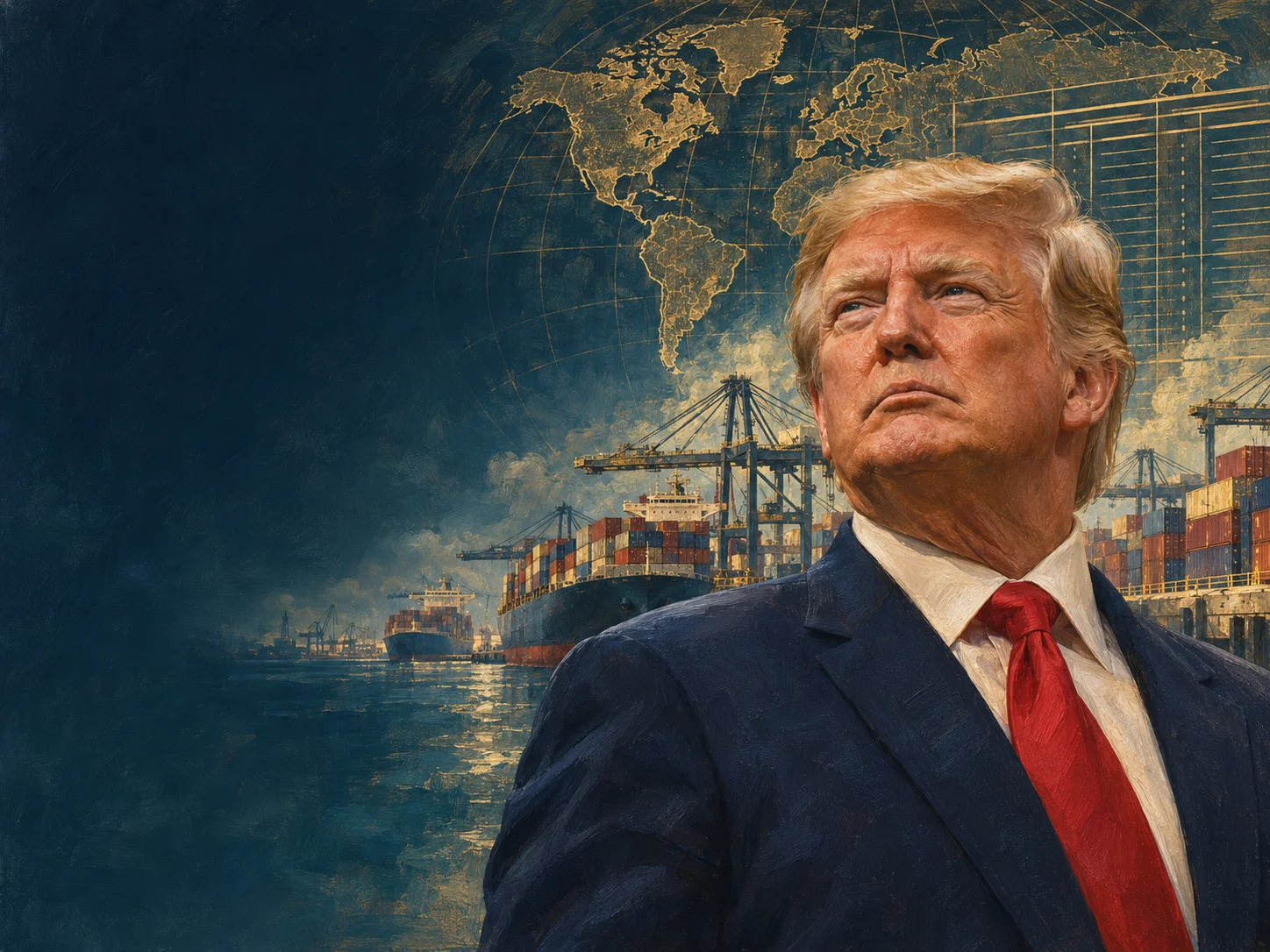
Primary government records, official agreement materials and independent federal analysis are linked beside the claims they support. Government estimates and announcements are attributed to their agencies; they do not independently establish every later job, contract delivery or community benefit. This profile distinguishes proposals, signed instruments, agreements in force and outcomes. The portrait is editorial art, not an archival photograph.
This is an interim profile through November 26, 2026. Terms, legal actions and reported outcomes may change.
Read the presidential timeline for the neighboring administrations.