THE LONG VIEW
Our lens follows decisions, institutions and the people who turn policy into relationships.
In 1972, a presidential visit to Beijing changed the diplomatic map. The Shanghai Communiqué also looked ahead to exchanges between people and the gradual development of trade. The possibility of business followed a political opening, but people would have to build the relationships that made it real.
That pattern recurs, though never in quite the same form. A president may negotiate a trade agreement, send a commerce secretary abroad, direct ambassadors to advocate for exporters, or organize agencies around a strategic industry. Those choices set the terms. Commercial diplomats—officials, business leaders, chambers, universities and civic connectors—do the patient work of making introductions count.
Each presidential profile asks what the leader inherited, whom they chose to support and why, which decisions continued earlier policy, and which marked a new approach. We read their own words against actions, outcomes and the people affected. An agreement begun under one president and completed under another belongs in both stories, with the timing made clear.
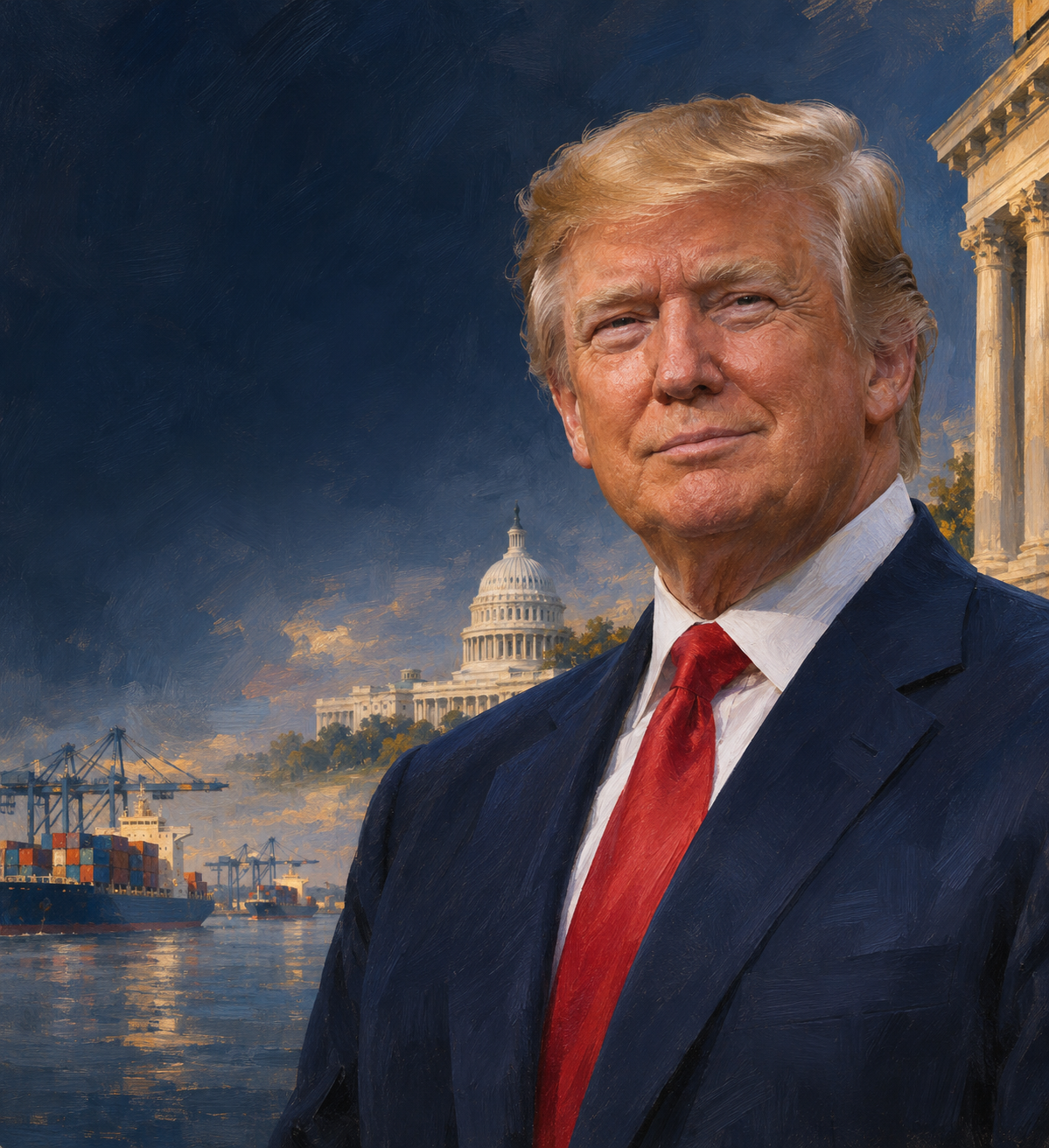
This story begins with Richard Nixon and reaches President Donald Trump’s second term. It considers the last five presidents in the context of their predecessors, rather than treating today’s commercial diplomacy as if it appeared from nowhere. The term has a specific government use; our editorial definition also recognizes the wider circle of people who create economic relationships across borders.
A PRESIDENTIAL TIMELINE
Opening doors.
Changing the rules.
Read each marker as a presidential choice, a new institution, or a moment when diplomacy and commerce met. Select a president to read the profile; a full individual feature is linked where available.
- Richard NixonEconomic leverage and the opening to China; the Shanghai Communiqué anticipates exchange and trade.
- Gerald FordThe Trade Act expands negotiating authority and frames market access as a diplomatic task.
- Jimmy CarterAn export policy, China normalization and a transfer of overseas commercial representation to Commerce.
- Ronald ReaganCanada trade negotiations and the Omnibus Trade and Competitiveness Act join access with enforcement.
- George H. W. BushExport outreach, a hemispheric initiative and NAFTA negotiations, including a San Antonio meeting.
- Bill ClintonRon Brown’s trade missions give the National Export Strategy a human face. Full Clinton profile →
- George W. BushTrade authority and agreements meet embassy-level advocacy for American firms.
- Barack ObamaExport promotion, investment attraction and “Jobs Diplomacy” connect overseas work to domestic jobs.
- Donald Trump · first termReciprocity, development finance, Deal Teams and the entry into force of USMCA.
- Joe BidenIndo-Pacific partnerships and a State-led Economic Diplomacy Action Group.
- Donald Trump · second termAmerica First trade priorities, AI export diplomacy and State’s Commercial Diplomacy Enterprise.
THE PRESIDENTIAL PROFILES
The office sets direction.
People do the work.
The policies differ sharply. The recurring question is how a presidential decision becomes access, advocacy and a lasting economic relationship.
Richard Nixon
Opening and leverage
Nixon’s China opening was driven by Cold War strategy, but it also reopened the possibility of human and commercial contact. He eased travel and trade restrictions before his 1972 visit. The Shanghai Communiqué acknowledged people-to-people exchanges and the prospect of developing bilateral trade on a basis of mutual benefit.
He also used economic pressure: his 1971 import surcharge was part of a wider currency and trade bargaining strategy. His profile reminds us that commerce can be a bridge and a negotiating instrument at the same time; neither guarantees an immediate business relationship.
Read the full Richard Nixon assessment by region →
Primary sources: Shanghai Communiqué · Office of the Historian
Gerald Ford
Authority and access
Ford signed the Trade Act of 1974 in January 1975. It expanded the authority to negotiate tariffs and other barriers and provided a framework for preferences for developing-country exports. Trade policy now had a more substantial set of tools for talks with partners.
At the Rambouillet summit later that year, Ford urged renewed multilateral negotiations. His administration showed that commercial access depends on rules built with other governments—and that those rules can carry political conditions, as the act’s Jackson–Vanik provisions did for certain nonmarket economies.
Read the full Gerald Ford assessment by region →
Primary sources: Ford Presidential Library fact book · Rambouillet record
Jimmy Carter
A lasting division of labor
Carter made export promotion a stated national priority in 1978, normalized relations with China in 1979 and completed the Tokyo Round trade agreements. The administration’s institutional change proved especially durable: a 1979 reorganization plan moved overseas commercial representation from State to Commerce, with the transfer taking effect April 1, 1980.
That move did not remove economics from diplomacy. It clarified a partnership still visible today: Commerce’s commercial specialists operate at U.S. missions, while State’s ambassadors and economic officers bring foreign-policy access and judgment. The people share a mission even when they work for different departments.
Read the full Jimmy Carter assessment by region →
Primary sources: National Export Policy · Reorganization Plan No. 3 · effective dates
Ronald Reagan
Competition and negotiation
Reagan pressed for open markets while arguing that the United States should respond to unfair barriers. His administration combined private-sector export outreach with negotiations that produced the U.S.–Canada Free Trade Agreement. The 1988 Omnibus Trade and Competitiveness Act sharpened the government’s trade toolkit.
The commercial-diplomacy story here is a dual one: business needs access to willing partners, and government-to-government negotiation can shape the terms of that access. The agreement with Canada took effect in 1989, after both sides completed their formal steps.
Read the full Ronald Reagan assessment by region →
Primary sources: Export outreach · 1988 trade act remarks
George H. W. Bush
Business at the table
Bush asked Commerce Secretary Robert Mosbacher to lead a governmentwide effort for smaller exporters and used business missions to make overseas access tangible. His Enterprise for the Americas initiative proposed a deeper hemispheric relationship through trade, investment and debt measures.
NAFTA negotiations gave that ambition a specific regional form. Bush joined Mexican President Carlos Salinas and Canadian Prime Minister Brian Mulroney in San Antonio for an October 1992 initialing ceremony; the countries signed the agreement in December. It entered into force in 1994 under Clinton. The San Antonio scene is a reminder that big agreements also pass through particular cities and rooms.
Read the full George H. W. Bush profile →
Primary sources: Export effort · San Antonio record · USTR history
Bill Clinton
Ron Brown’s human diplomacy
Clinton’s first National Export Strategy in 1993 organized federal export assistance across agencies. Commerce Secretary Ronald H. Brown made that strategy visible through high-profile trade missions and direct advocacy for American companies. Brown’s own testimony emphasized help for businesses of different sizes, not just the largest names.
The administration also pursued market-opening agreements and, in 2000, legislation that created African and Caribbean trade preferences. For this magazine, Brown’s place in the story is especially personal: commercial diplomacy had a cabinet-level champion who understood that opportunity often begins when someone brings people into the same room.
Read the full Bill Clinton assessment by region →
Primary sources: Brown on the export strategy · Trade and Development Act · Related feature: Ronald H. Brown
George W. Bush
Agreements and ambassadors
In April 2002, Bush made the case for trade promotion authority in the State Department’s Benjamin Franklin Room, speaking to an audience that included ambassadors and business leaders. Congress restored negotiating authority that year; his administration pursued regional and bilateral agreements.
The embassy story matters as much as the treaty story. State’s economic leadership described ambassadors advocating for U.S. firms and working with Commerce, including in countries without a permanent Commerce presence. Business diplomacy was not only a paper agreement; it was also a conversation carried by people at a post.
Read the full George W. Bush profile for the regional account and primary records.
Primary sources: Benjamin Franklin Room remarks · State economic diplomacy remarks
Barack Obama
Exports, investment and jobs
Obama’s 2010 National Export Initiative brought State, Commerce and other agencies into a coordinated push to help businesses sell abroad, remove barriers and use trade missions. The White House said ambassadors would put greater emphasis on commercial diplomacy and embassy business liaisons.
In 2011, he established SelectUSA to coordinate federal investment-promotion resources and connect potential investors with American places. State described a “Jobs Diplomacy” approach in 2012: overseas missions could help exporters and also encourage investment at home. The goal was to connect international outreach to communities and employment in the United States.
Read the full Obama profile →
Primary sources: National Export Initiative · SelectUSA order · Jobs Diplomacy
Donald Trump
First term · reciprocity and deals
Trump’s first administration emphasized reciprocity, trade enforcement and economic security. It also made deal support more explicit. State and Commerce launched a Washington-based Central Deal Team in 2020 to connect embassy Deal Teams with interagency help for overseas opportunities.
The U.S. International Development Finance Corporation began operating in 2020 after the 2018 BUILD Act, adding a financing instrument to the broader economic toolkit. USMCA entered into force in July 2020. Those actions show several different mechanisms at work: negotiations set terms, financing can support projects, and embassy networks can help American firms pursue specific business.
Read the full Donald Trump first-term profile →
Primary sources: Deal Teams · DFC begins operations · USMCA entry
Joe Biden
Partnerships and coordination
Biden’s administration connected trade and investment to supply-chain resilience, workers and strategic partnerships. It launched the Indo-Pacific Economic Framework with partners in 2022, seeking cooperation across trade, supply chains and other economic issues.
A June 2024 presidential memorandum established the Economic Diplomacy Action Group, chaired by the Secretary of State with Commerce and the U.S. Trade Representative as vice chairs. The group was designed to bring financial, diplomatic and commercial tools into closer coordination. The authority came from a 2019 law; its later use under Trump shows institutional continuity even when policy priorities change.
Read the full Joe Biden profile →
Primary sources: IPEF launch · Economic Diplomacy Action Group memorandum
Read the full Donald Trump current-term profile →
THE CURRENT ADMINISTRATION · 2025–PRESENT
Donald Trump and the new State Department machinery.
President Trump’s second term is bringing commercial cases closer to the center of State’s economic work. The emphasis is on American market access, strategic supply chains, domestic industry, energy and technologies where diplomacy and business interests meet.
What is new is not the idea that diplomats support business. The more specific development is a structure for tracking opportunities, escalating cases and coordinating agencies around them.
Economic security sets the agenda.
The America First Trade Policy directs reviews by Commerce and USTR and calls for a joint State–Commerce review of export controls. The White House places trade balances and industrial capacity within its foreign-policy priorities.
AI exports become a diplomatic project.
An executive order on American AI exports assigns the Secretary of State and the Economic Diplomacy Action Group roles in aligning diplomacy and federal financing for selected export packages. The group itself was established under Biden in 2024.
State launches a Commercial Diplomacy Enterprise.
In July 2026 congressional testimony, Assistant Secretary Caleb Orr said State had launched the CDE earlier that year: one platform for commercial cases, processes to bring significant opportunities to senior leadership and ways to share deals with other agencies. It includes cases State supports through Commerce’s Advocacy Center.
Cabinet-level coordination becomes visible.
Secretary of State Marco Rubio addressed the Economic Diplomacy Action Group at State. The administration is using an interagency forum created by its predecessor to pursue its own priorities.
HOW THE SYSTEM WORKS
One mission.
Different instruments.
State brings ambassadors, economic officers, relationships with foreign governments and diplomatic tools. Commerce runs the U.S. Commercial Service, whose trade specialists work at home and in embassies, and its Advocacy Center helps firms compete for foreign contracts. USTR leads trade negotiations. The president can set priorities across all three; coordination determines how a specific opportunity moves.
Orr’s testimony reported that State’s Partner Posts—economic officers who facilitate Commercial Service offerings where Commerce has no direct overseas presence—delivered 116 client-verified commercial wins worth more than $13.7 billion in fiscal 2025 and assisted 3,652 U.S. companies. These are State’s reported program results, a concrete glimpse of the work behind the phrase “commercial diplomacy.”
Sources: State testimony · U.S. Commercial Service · USTR
THE PEOPLE BEHIND THE POLICY
What endures is
the relationship.
From Nixon’s opening to Trump’s case-management effort, presidents have chosen different markets, tools and priorities. The strongest commercial-diplomacy story is never only about the White House. It is about the people who turn an opening into an introduction, an introduction into trust, and trust into an opportunity that communities can use.
That is why U.S. Commercial Diplomat tells the human story. Our research product, the U.S. Commercial Diplomacy Index, explores the places and economic connections behind it.