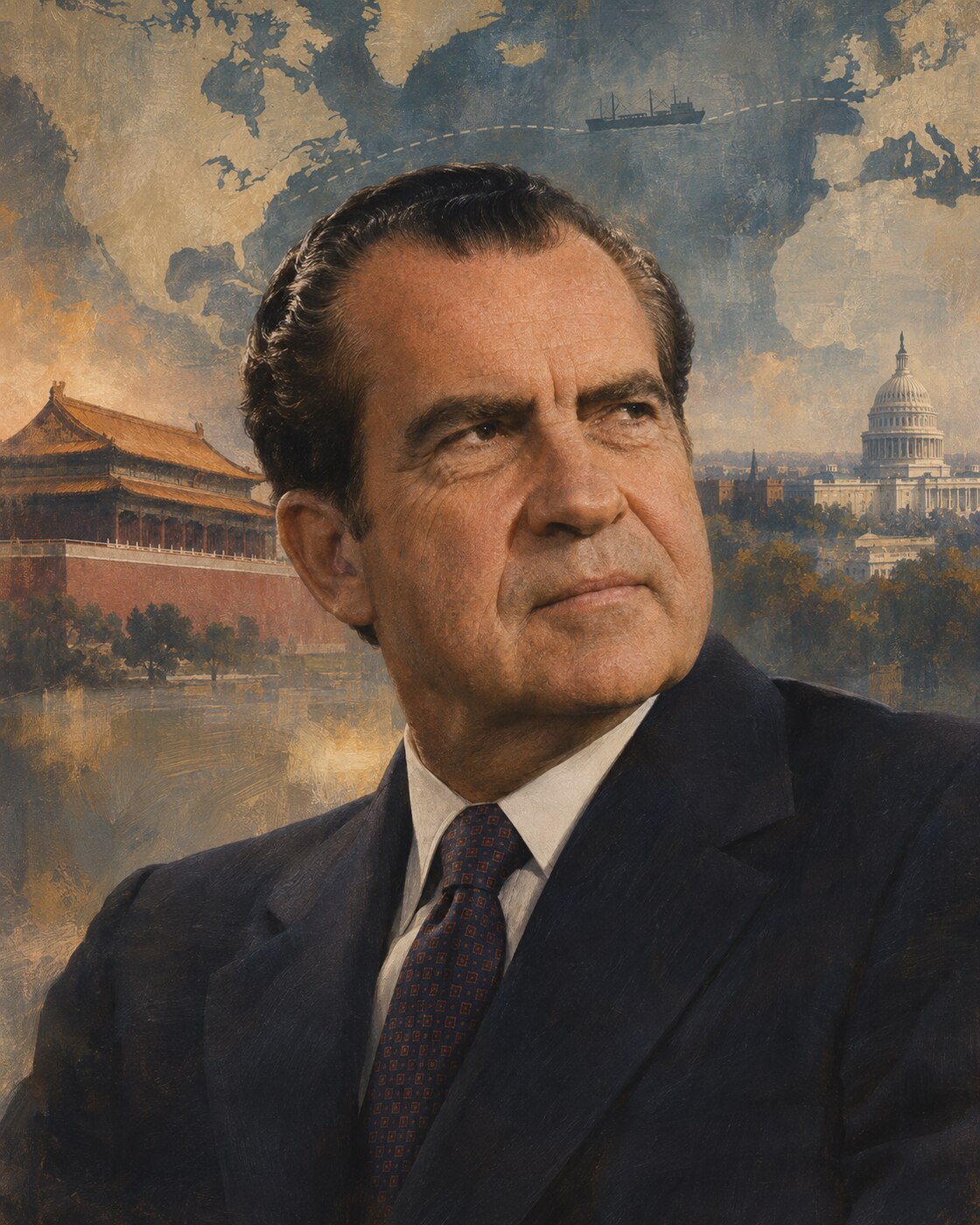
JANUARY 20, 1969 — AUGUST 9, 1974
A president who treated the world economy as an arena of diplomacy
Nixon did not have a single policy called “commercial diplomacy.” The phrase is this magazine’s lens on a presidency in which markets, currencies, aid, credit, technology and strategic negotiation repeatedly met. His public language invited a more open trading world. His actions also used economic power to bargain and, at times, to punish.
In a 1969 trade message to Congress, Nixon argued for wider trade, reciprocity and a better chance for developing nations to sell into advanced markets. In August 1971 he took the opposite-looking step of temporarily adding a 10 percent surcharge to dutiable imports while suspending the dollar’s conversion into gold. The move sought leverage over trading partners and exchange rates, as the State Department’s historical account explains. These were parts of the same governing instinct: open a door when it served American interests, but be willing to change the terms of entry.
This series asks the same questions of every term: What did the president inherit? Whom did he choose to support, and why? Which steps continued prior policy, which were his own departures, and what did later administrations carry forward or reverse? Nixon inherited Cold War alliances and restrictions on China; he kept some structures, changed others and forced allies to renegotiate economic terms. A president’s preference, an agency’s implementation and a successor’s result are different kinds of evidence.
The State Department’s documentary preface to the foreign-economic-policy records cautions that Nixon and Henry Kissinger were more absorbed by Vietnam, the Soviet Union and China than by economic questions in their own right. That warning belongs at the front of this story. Foreign economic policy often served a larger security design; no reader should mistake each trade proposal for a completed commercial outcome.
THE INSTITUTIONAL CHOICE
Who represented American commerce abroad?
Nixon’s January 1971 memorandum created a Council on International Economic Policy to consider trade, investment, payments and finance together. State chaired its operations group. Commerce, Treasury, the Special Trade Representative, the Export–Import Bank and other agencies each held part of the tool kit. The 1969 foreign-assistance law also authorized the Overseas Private Investment Corporation as an instrument for private investment in development.
That division of labor was contested. Commerce Secretary Maurice Stans argued in 1971 for a larger Commerce role in overseas representation; Secretary of State William Rogers objected. In May 1973 Nixon chose to leave economic and commercial representation at embassies and consulates with State and the Foreign Service, according to a State Department archival note quoting his announcement. The Carter administration’s later reorganization would move much of that overseas commercial function to Commerce. For Nixon’s term, the diplomatic post remained a central place where political and business questions met.
FOUR REGIONAL READINGS
How Nixon saw the world—and what the record shows
These chapters distinguish announced aims from actual steps, and strategic relationships from measurable commercial results. The regions are editorial groupings; Nixon’s decisions crossed them constantly.
Africa relegated;
partnership promised.
Nixon’s public policy offered trade and investment. His private instructions placed most African affairs among the lowest priorities, and his words and choices on southern Africa undercut the promise of an equal relationship.
Priority in the president’s own words
Before approving a formal Africa policy, Nixon had already drawn a different internal map. In a March 2, 1970 memorandum to senior aides, he placed African affairs outside the Middle East crisis, most of Latin America and much of Asia among matters to be delegated unless only the president could decide them. State Department editors describe his Africa priorities as among the lowest. Nixon wrote of these regions that what happens in those parts of the world is not, in the final analysis, going to have any significant effect
on the success of U.S. foreign policy in the foreseeable future. The memo does not say he took no action in Africa; it establishes where he chose to spend his time and attention.
The public view
Secretary of State William Rogers submitted a new Africa policy in March 1970, approved by Nixon that same day. It called for cooperation on development, technical assistance, trade, private investment and exchanges while recognizing African sovereignty. The policy paper said African leaders wanted a more equitable commercial relationship, not an American script for their development. That was an important statement of intent, but the document itself did not commit precise new funding levels.
In his 1972 report to Congress, Nixon declared that Our interest in African trade and investment opportunities matches the African interest in American goods
. He described growing U.S.–African trade, reported an approximately $400 million American trade surplus for 1971, and pointed to sugar access and a planned regional trade center in Nigeria. Those are the administration’s contemporary claims and plans, not proof that every proposed institution opened. A July 1972 internal memorandum reported Nigerian obstacles to the Lagos center, a consulate in Port Harcourt and an investment guarantee program. One reason was Nigeria’s anger at resumed U.S. imports of chrome from white-minority-ruled Rhodesia in violation of U.N. sanctions.
Where private words met policy
A September 1971 White House tape transcript records Nixon calling African leaders those poor, child-like Africans
after a meeting with leaders from the Organization of African Unity. This racist stereotype makes the public language of equal partnership harder to credit. In that same conversation he said I am for the Byrd Amendment
and wanted the United States to continue buying Rhodesian chrome despite objections from State. His comments and policy preference belong in the assessment of how the administration treated African leaders, not as an aside detached from commercial decisions.
The southern Africa record is unusually revealing. A 1970 decision discouraged U.S. investment and Export–Import Bank credit involving South West Africa, now Namibia, yet rejected a general sanctions precedent for South Africa and Portuguese territories. In a 1971 briefing memorandum, Nixon wrote that he agreed with the Byrd Amendment allowing Rhodesian chrome imports, while State opposed it publicly. The public and private positions cannot be collapsed into a uniform pro-sanctions account. The Nigerian response shows that choices about minerals and racial rule affected the prospects for commercial trust.
Whom he supported—and why
Emperor Haile Selassie of Ethiopia: Nixon told him in July 1969 that Ethiopia received approximately 60 percent of U.S. military-assistance funds available for Africa and promised continued special attention. He cited Ethiopia’s security, the emperor’s regional role and concern about Soviet-armed Somalia. A 1973 presidential decision planned continued military training and aid while the United States reduced its Kagnew communications presence. This was a strategic security relationship, not evidence that all African governments received comparable backing.
President Joseph Mobutu of Congo, later Zaire: In an August 1970 meeting, Nixon connected his regard for Mobutu’s leadership to political stability and prospects for American private investment. Acting on Nixon’s instructions, Kissinger arranged authorization for Mobutu to purchase three C–130 aircraft and waived U.S. administrative charges; an authorization is not a claim that every aircraft had been delivered. An American briefing described Mobutu as pro-Western and anti-communist, but also acknowledged rule by decree and an election with no rival presidential candidate. He was an ally useful to Washington in Central Africa and attractive to investors, not an exemplar of democratic governance.
Portugal and white-minority-ruled southern Africa: Nixon’s January 1970 decision retained the arms embargo on South Africa and limited U.S. naval calls, yet kept a consulate in Rhodesia short of recognition and made a dual-use equipment exception for NATO ally Portugal. He approved a gold-market understanding with South Africa, writing that the United States should look after its own national-security and monetary interests. A 1971 conversation with Portugal’s prime minister ties his accommodation to the Azores base agreement. In another private exchange, Nixon said he would not pursue African demands at the cost of Britain or other allies, while weighing domestic allies and votes over Taiwan. These were selective strategic and commercial choices, with restrictions still in place; they did not amount to formal recognition of Rhodesia or an across-the-board lifting of the South African embargo.
Other African leaders made their economic concerns directly. During a 1973 Oval Office conversation, Zaire’s President Mobutu argued that U.S. commodity stockpile sales and higher wheat prices strained his country’s finances. Nixon promised consultation; the record does not show a solution from that conversation. In the Sahel, Nixon appointed a drought-relief coordinator, and a 1973 memorandum described U.S. relief commitments and the need for African-led recovery. This is economic diplomacy in the practical sense of responding to partners’ needs, but relief is not the same as an export success. In North Africa, Nixon’s June 1974 understanding with Egypt’s Anwar Sadat anticipated joint cooperation after the Middle East peace opening. Egypt belongs here geographically, although that initiative followed a distinct Middle East security track.
What he wrote after leaving office
In his 1988 book 1999: Victory Without War—the title names a future year, not its publication date—Nixon asserted that after colonial independence millions are now far worse off than they were under European rule
. He grouped parts of Africa with regions in Asia, Latin America and Eastern Europe in a sweeping Cold War account of Soviet influence. This is his later published perspective on decolonization, not a record of an action during his presidency. The 1970 memorandum and 1971 tape are the more direct evidence for this profile.
Assessment: The weight of the evidence points to deprioritization, not a sustained presidential commitment to African partnership. Nixon approved a formal trade-and-development policy, but his private priority memo, contemptuous stereotype, Rhodesian chrome stance and resistance to a wider reappraisal tell a contrary story. State Department editors describe his principal 1973–74 African interest as Sahel drought relief and note his resistance to reassessing broader policy. African objections had practical consequences for proposed commercial work in Nigeria.
An opening is a beginning,
not a market.
China was Nixon’s most consequential diplomatic opening. Japan and South Asia show why the region cannot be reduced to a single success story.
China: a strategic turn with commercial channels
Nixon’s approach began in Cold War strategy, but it deliberately lowered barriers to contact. His April 1971 directive relaxed travel, currency, shipping and selected trade controls with the People’s Republic of China; a June decision broadened general licensing for nonstrategic goods, permitted Chinese imports and addressed grain. These were controlled steps, not a declaration of free trade.
During Nixon’s February 1972 trip, he and Premier Zhou Enlai issued the Shanghai Communiqué. It contemplated exchanges in science, technology, culture, sports and journalism and the progressive development of trade on a basis of mutual benefit. It also preserved sharp differences over Taiwan. U.S. diplomatic recognition of Beijing came in 1979, after Nixon’s presidency. The communiqué opened a channel and a direction of travel; it did not settle the relationship.
A January 1973 planning memorandum reported more than $170 million in bilateral trade during 1972, while noting unresolved financial claims, blocked assets and most-favored-nation questions. Liaison offices followed in 1973. The human detail lies in a later National Security Council memorandum: officials worried that a private U.S.–China trade council favored large exporters and that a heavy government presence at the Canton Fair might crowd out a more broadly representative exchange. The new relationship needed intermediaries, but it also raised the question of whose business would be heard.
Japan, South Asia and the cost of strategy
Japan was a treaty ally and major commercial partner. A 1971 interagency assessment recorded tensions over textiles, market access, exchange rates and the surprise China opening. Nixon’s 1972 meeting with Prime Minister Kakuei Tanaka pursued tariff and nontariff barrier reductions and a more manageable bilateral imbalance. The relationship illustrates how security cooperation could coexist with hard bargaining between economic competitors.
Pakistan’s leadership helped provide a secret channel to Beijing, but the administration’s tilt toward Pakistan during the 1971 crisis came amid repression in East Pakistan. U.S. officers in Dacca sent a dissenting telegram objecting to the American response. The strategic opening to China damaged relations with India and put goodwill with Bengali leaders at risk. It also brought the suffering of people into sharp relief: that cannot be measured as a trade balance.
In Vietnam, the Paris Peace Accords of January 1973 addressed a war, not an achieved commercial partnership. The State Department’s documentary preface describes the failure to secure a stable political settlement. Regional context matters, but we should not count a fragile peace agreement as a business result.
Partners, counterparts and clients
China and Japan were different relationships. Mao Zedong and Zhou Enlai were strategic counterparts with whom Nixon opened dialogue, not leaders whose government he endorsed; the Shanghai Communiqué left their disagreement over Taiwan on the record. Japan remained a treaty ally. Nixon worked with Prime Minister Eisaku Sato on Okinawa’s reversion, then with Kakuei Tanaka on market access and the trade imbalance. Security partnership did not remove commercial friction.
Yahya Khan, Nguyen Van Thieu and Park Chung Hee received different forms of support. Pakistan’s president helped Nixon reach Beijing, and the White House tilted toward his government during the 1971 crisis despite diplomats’ warnings about repression in East Pakistan. Nixon supplied South Vietnam’s President Thieu with military support but also pressed him toward a negotiated settlement. He reaffirmed the South Korean alliance with Park while withdrawing 20,000 American troops. None of these relationships can be counted as a uniform trade success or an endorsement of their domestic conduct.
In West Asia, the Shah of Iran was a favored security partner. Nixon told Mohammad Reza Pahlavi in Tehran in May 1972 that the visit symbolized strong U.S. support for friends in a region he feared the Soviet Union might penetrate. A second conversation discussed specific advanced aircraft and weapons for Iran. Nixon reaffirmed Israel’s military security under Prime Minister Golda Meir and the U.S. resupplied Israel in the 1973 war, heightening tension with Arab oil producers. He later sought an active partnership with Saudi King Faisal in 1974, but the oil embargo showed how a partner could resist Washington’s preferences. Gulf security, energy and regional influence—not simply exports—drove these relationships.
Assessment: China demonstrates that political access and person-to-person exchange can precede commerce. Japan demonstrates that partners negotiate their own terms. South Asia and Vietnam make a purely celebratory account of the region untenable.
Allies, competitors
and a divided continent.
Western Europe grew as an integrated economic power. Across the Iron Curtain, trade became a possible instrument of détente, with real political limits.
The Atlantic economy under pressure
On August 15, 1971, Nixon suspended the dollar’s conversion into gold and imposed a temporary surcharge on dutiable imports. The move pressed major trading partners to change exchange rates and trade barriers. A December realignment at the Smithsonian Institution provided only a short-lived adjustment; fixed exchange rates gave way to floating by 1973. The State Department’s documentary summary and retired historical essay explain why a domestic economic announcement became a diplomatic negotiation with Europe and Japan.
Nixon publicly called 1973 a “Year of Europe”, supporting renewed Atlantic cooperation and trade talks. Behind the slogan lay disagreement over European Community enlargement, preferential arrangements and agricultural policy. A February 1973 conversation shows bargaining over those issues; a private draft memorandum reveals Nixon’s anxiety about a more unified Europe, a sharper tone than his public endorsement of European integration. A December 1973 decision kept pressure in negotiations. The available record supports an account of continued bargaining, not a tidy resolution.
Détente’s commercial promise—and its boundary
The 1972 Moscow summit advanced strategic talks alongside economic discussions. Later in Washington, the United States and Soviet Union signed an October 1972 trade agreement. A 1973 grain understanding contemplated annual purchases subject to actual contracts. Nixon viewed trade as a way to support a less confrontational relationship, but technology controls, credit, emigration policy and congressional authority constrained what could be delivered. Later congressional conditions linked Soviet trade benefits to freedom of emigration; the two governments nullified the original agreement in January 1975 following Soviet objections to those conditions. This occurred after Nixon left office. It is a mistake to count proposed Soviet preferences as a durable Nixon-era achievement.
After the 1973 oil embargo, Nixon’s administration convened energy-consuming countries, including Europeans and Japan, for a February 1974 Washington energy conference. Oil prices and supply had become part of alliance management. For businesses and families, the point was immediate: a diplomatic relationship could affect the energy available to move goods, keep factories operating and heat homes.
Allies and negotiating counterparts
Nixon regarded Britain’s Edward Heath as an especially trusted European partner, privately calling him his one solid friend in Europe. He relied on the British alliance but could not dictate Britain’s course inside the European Community. West Germany’s Willy Brandt was vital to NATO and East–West relations; their 1973 meeting sought to avoid an Atlantic economic war, although Washington had been wary of Brandt’s Ostpolitik. France’s Georges Pompidou was an independent interlocutor on European autonomy, monetary rules and trade, as a 1973 conversation shows. Nixon negotiated with Soviet leader Leonid Brezhnev as a strategic rival, not an allied government he supported.
Portugal’s Marcello Caetano illustrates the cost of access. A 1971 Nixon–Caetano conversation tied the relationship to a newly negotiated agreement for U.S. use of the Azores and to Nixon’s desire to avoid positions at the United Nations unfavorable to Portugal. That choice mattered to people living under Portuguese colonial rule in Africa. The Africa chapter examines how strategic accommodation complicated the administration’s public language about self-determination.
Assessment: Nixon saw Europe as an indispensable partner and an increasingly self-confident economic competitor. His Soviet opening showed what commercial ties might support, while later political conditions showed what they could not simply bypass.
A mature partnership
meets its contradictions.
The hemisphere was where Nixon most plainly spoke of mutual respect and developing-country market access—and where the gap between language and policy was hardest to ignore.
The partnership proposal
In an October 1969 address, Nixon called for a more mature partnership with Latin America. He proposed multilateral development decisions, regional economic integration, fewer barriers to Latin exports, consultations before trade changes and generalized tariff preferences for developing countries. He cited the Andean Group as an example of regional initiative. These were policy proposals, not evidence that every promised preference or consultation had already taken effect.
Canada and Mexico required different conversations. Nixon’s April 1972 address to Canada’s Parliament acknowledged a close trading relationship and Canada’s independent choices even as the countries disagreed over monetary and trade measures. A June 1972 communiqué with Mexico’s President Luis Echeverría combined proposed trade preferences with the Colorado River salinity dispute, science and technology, labor, and environmental issues. A border relationship could not be described by exports alone.
The test of consultation and consent
The 1971 surcharge on dutiable imports applied to Latin America, a jarring counterpoint to the 1969 promise. An internal 1973 interagency review acknowledged that the region had not received advance notice of important U.S. decisions, that preferences had been delayed, and that positive programs had fallen short. That unusually candid internal assessment is stronger evidence of implementation limits than a retrospective slogan. Nixon proposed trade reform again in April 1973; the eventual Trade Act was signed by Gerald Ford in January 1975, after Nixon’s resignation.
Chile exposes the gravest contradiction. After Salvador Allende took office, Nixon’s November 1970 National Security Decision Memorandum 93 directed maximum feasible pressure, restrictions on bilateral assistance, efforts to limit international credit and Export–Import Bank support, and consultation with other governments. Chile’s 1971 nationalization of U.S.-owned copper interests later sharpened the economic dispute, but this was also a political campaign against an elected government. State Department archival editors describe wider U.S. intervention and destabilization. Chile’s 1973 coup and later repression make it essential to examine whose rights and sovereignty were absent from a business-centered account. The documentary record should be read carefully; pressure on Allende is established by the cited directive, while claims about specific U.S. operational control of the coup require their own evidence.
Other relationships were not uniform. Disputes with Brazil over soluble coffee and with Venezuela over oil and trade arrangements show the granular negotiations behind a regional label. The Americas were not a single market or a single diplomatic voice.
The governments he favored—and those he opposed
Nixon cultivated Brazilian President Emílio Garrastazu Médici’s military government as a South American anti-communist partner with an economy open to foreign investment. That was a deliberate relationship with an authoritarian incumbent. In Chile he took the opposite course toward elected President Salvador Allende: the 1970 directive ordered economic and diplomatic pressure, and State Department archival editors describe subsequent destabilization and the administration’s recognition of the post-coup junta. Recognition is a fact of policy; it does not itself prove U.S. operational control of the coup.
Mexico’s Luis Echeverría and Canada’s Pierre Trudeau were negotiating neighbors, not dependent clients. Nixon’s 1972 communiqué with Mexico addressed trade preferences, border water and labor; his address in Canada acknowledged an independent trading partner amid monetary and tariff tensions. His choices in the hemisphere followed anti-communist alignment, investment and bargaining power more consistently than his promise of a single equal partnership.
Assessment: Nixon articulated a less paternalistic partnership, but the administration’s own review and the Chile record show profound inconsistency. Trade diplomacy worthy of that name has to be judged by the autonomy and treatment of partners as well as access for American firms.
THE YEARS IN OFFICE
A timeline of decisions and consequences
- Trade and development as a public promise.
Nixon’s November trade message advocated an open trading world; his hemisphere address sought a more mature partnership. A foreign-assistance law authorized OPIC.
- Africa’s low priority, a public policy, and Chile pressure.
Nixon’s March internal memo relegated most African affairs; later that month, he approved a trade-and-investment Africa policy. In November, NSDM 93 instructed pressure on Allende’s Chile.
- Economic coordination, a China channel, and the dollar shock.
He created CIEP; trade and travel controls toward China eased; on August 15, he suspended gold convertibility and imposed an import surcharge. A December currency realignment followed.
- Beijing and Moscow.
The Shanghai Communiqué anticipated exchanges and trade while leaving major questions unresolved. The Soviet trade agreement pursued economic ties within détente. The Nigerian trade-center dispute exposed friction between U.S. ambitions and African concerns.
- Institutions and their limits.
Nixon proposed trade reform, left overseas commercial representation with State and the Foreign Service, and faced the oil crisis. The Paris Peace Accords did not end the political conflict in Vietnam.
- Energy coordination and an unfinished presidency.
The Washington Energy Conference gathered consuming nations. Nixon resigned on August 9. Ford signed the resulting Trade Act in January 1975, after Nixon’s term.
THE EDITORIAL ASSESSMENT
The opening mattered.
The terms mattered too.
Nixon’s strongest commercial-diplomacy legacy was not a single export number. He created channels and institutions through which economics became part of high diplomacy: a China relationship that could carry people and trade, a council for coherent international economic policy, and an explicit choice to keep embassy commercial representation with State. He also demonstrated how a currency decision, a tariff, an investment guarantee or withheld credit could change a diplomatic relationship.
The record does not permit an uncomplicated celebration. Nixon’s own words and priorities concerning Africa, and African partners’ objections to Rhodesian chrome, challenge the idea of an equal partnership; Latin American governments confronted policies that contradicted promised consultation; Chile suffered deliberate economic pressure on an elected government; and the Pakistan tilt exposed the human cost of strategic calculations. Several proposals became law or unraveled only after he left office. Judging the period requires attention to both American initiative and the choices, objections and rights of other people.
Evidence and editorial method
This account draws chiefly on the U.S. Department of State’s Foreign Relations of the United States documentary series—presidential memoranda, diplomatic records, internal reviews and editor-verified contextual notes—and on contemporary presidential speeches reproduced by the American Presidency Project. Each consequential claim above links to its supporting record. The State Department’s Milestones essays are retired and not maintained; where used, they provide orientation beside contemporaneous documents, not sole authority for a disputed point.
“Commercial diplomacy” is a present-day editorial frame, not a claim that Nixon used the term as an official program name. A directive establishes an intention; a memorandum records an assessment; a presidential report states what an administration said; none alone proves a promised center opened, a trade benefit reached every firm or a negotiation succeeded. Dates after August 9, 1974 are identified as subsequent developments. The regional categories describe this magazine’s analysis of policy, rather than a precise geographical division within the Nixon White House. The linked Commercial Diplomacy Index country profiles describe present-day countries and datasets; historic borders and names, including Zaire, Rhodesia and West Germany, are explained at the point of the link. They are research pathways, not contemporary evidence for the historical claims.