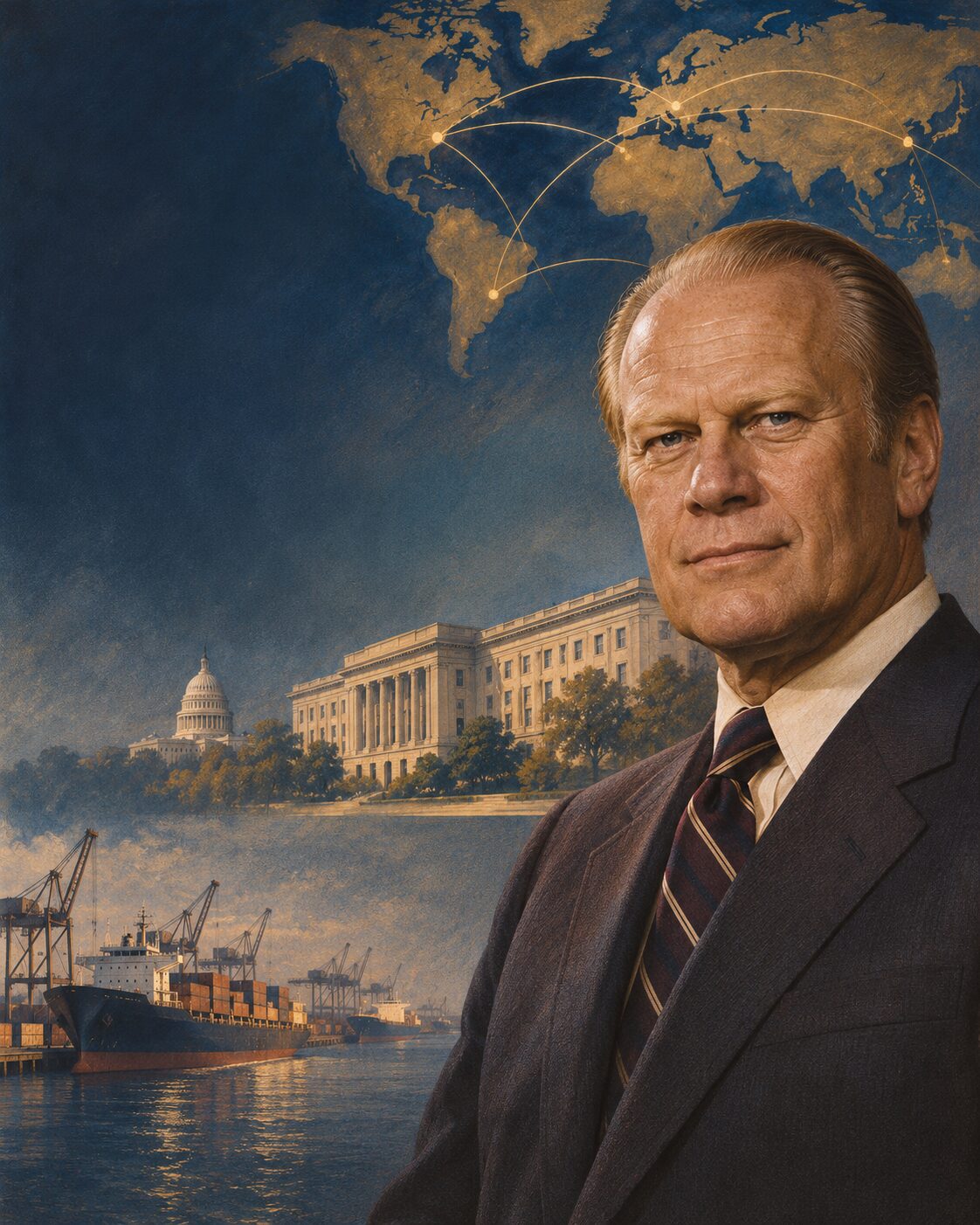
AUGUST 9, 1974 — JANUARY 20, 1977
The president who had to turn an opening into a working relationship
Ford did not start the China opening, the oil crisis or the trade bill he signed. He did decide how an administration would work with those inheritances—and which partners would receive its attention, credit, security guarantees and patience.
He took office after Nixon’s resignation, amid recession, inflation, energy insecurity and doubts about American credibility. The Nixon profile traces the openings and contradictions he inherited. Ford’s first international economic test was whether the United States could promise openness while domestic industries, workers and foreign governments all sought protection or relief. At the January 3, 1975 Trade Act signing, Ford described a commitment to an open world economic order
. The bill had been proposed by Nixon in 1973 and completed by Congress in December 1974; the legislative record matters to the assignment of credit.
This profile uses commercial diplomacy as an editorial lens, not as the name of a single Ford program. It asks what he inherited, which actions were distinctly his, whose interests he favored, and whether a signature, diplomatic statement or announced package led to an actual result. The answer is mixed: trade law and economic summitry endured, but several negotiations remained open when he left office. Some security relationships put human rights at odds with the language of partnership.
THE INSTITUTIONAL CHOICE
Who carried the economic conversation?
The Trade Act of 1974 gave U.S. negotiators broader tariff and nontariff bargaining authority, remedies for unfair or injurious imports, and adjustment assistance for workers, firms and communities. Ford put the law into operation, including the Generalized System of Preferences for eligible goods from developing countries effective January 1, 1976. Eligibility was selective, and the act’s conditions for nonmarket economies brought human rights into the trade debate.
Ford’s September 1974 order created an Economic Policy Board while retaining Nixon’s Council on International Economic Policy. Treasury, Commerce, State, the Special Representative for Trade Negotiations, the Export–Import Bank and others held different parts of the economic toolkit. Overseas commercial representation at embassies still belonged principally to State and the Foreign Service, following Nixon’s 1973 decision; a later Carter reorganization moved major responsibilities to Commerce. The people doing the work were diplomats, trade negotiators, agency officers, businesses and their counterparts abroad. The International Energy Agency, established in November 1974 after a Nixon-era consumer-country initiative, provided another forum for shared responses to oil insecurity.
Ford joined the leaders of France, West Germany, Italy, Japan and Britain at the first economic summit at Rambouillet in 1975, then hosted a seven-country meeting with Canada in Puerto Rico in 1976. These meetings put money, trade, energy and development on the same leaders’ agenda. They did not themselves finish the Tokyo Round trade negotiations; final agreements came under Carter in 1979.
FOUR REGIONAL READINGS
Continuity at the top;
different tests on the ground
Each chapter identifies partners and adversaries, the interests that shaped Ford’s choices, and the gap between intention and implementation. “Africa,” “Asia,” “Europe” and “the Americas” organize this magazine’s analysis; economic and security decisions crossed those boundaries.
More attention.
A contested purpose.
Ford’s administration gave Africa more high-level attention than Nixon had. Its record also shows how minerals, oil, Cold War calculations and minority rule shaped the limits of that attention.
A change in priority, with pressure from outside the White House
The State Department’s documentary introduction says high-level interest in Africa rose markedly after Ford succeeded Nixon and credits pressure from the Congressional Black Caucus. Kissinger traveled to sub-Saharan Africa in 1976, while officials reconsidered military assistance and development. This change should not be described as Ford’s solitary initiative: African leaders, members of Congress and State officials pushed the agenda. Ford described a desire for African prosperity through African effort and assistance from developed nations, but assistance and autonomy were not always aligned.
Nigeria was an especially revealing commercial test. A candid March 1975 State memorandum said it supplied about one-fifth of U.S. foreign crude, hosted approximately $1 billion in American investment and had a U.S. trade deficit above $2 billion in 1974. Yet officials acknowledged Nigerian resentment over perceived American neglect and its exclusion from new tariff preferences under oil-producer restrictions. In that document, the numbers are contemporaneous U.S. government estimates, not a present-day comparison. Ford publicly questioned blanket OPEC-country exclusions; the exclusion was not simply erased by his objection. The relationship called for listening to a major African partner rather than assuming oil purchases made it equal.
Rhodesia, Angola and the difference between negotiation and outcome
In September 1976, Ford welcomed proposals for Rhodesian majority-rule negotiations, thanked British Prime Minister James Callaghan, African presidents and South Africa’s John Vorster, and said, We will not prescribe for the peoples of Africa what only they can bring about.
The statement acknowledged African agency. The talks subsequently stalled; independence and majority rule did not arrive in Ford’s term. He supported repeal of the U.S. exception permitting Rhodesian chrome imports, a position he said predated his presidency, but the embargo was restored only when Carter signed the bill in March 1977.
Angola tells a less reassuring story. Ford approved covert assistance to anti-MPLA factions during its civil war, while Cuban and Soviet involvement intensified Cold War fears. He opposed the Senate’s December 1975 cutoff of that assistance. To describe Angola only as a struggle against outside intervention would obscure the United States’ own intervention. It is also wrong to make a war and its human cost into a measure of export success.
Whom did he back, and why?
Ford supported Mobutu’s Zaire as a pro-Western strategic and mineral partner. A 1976 Kissinger memorandum proposed a roughly $50 million package of grants, food and export credit, citing the copper crisis, U.S. investment and the country’s political importance. The archival note records Ford’s approval of a budget amendment; it does not prove every proposed credit or shipment was delivered. This relationship continued Nixon’s selective support for Mobutu, whose authoritarian rule is part of its context. Ford also authorized an African military-assistance ceiling waiver covering proposed aid and credits to several governments, including Ethiopia, Kenya, Liberia and Zaire, in the face of Soviet and Cuban influence.
In a June 1976 meeting with Sudan’s Jaafar Nimeiri, Ford promised to pursue economic assistance and encourage private enterprise after relations had been normalized. Kissinger’s meeting with Kenya’s Jomo Kenyatta showed Washington valuing a stable pro-Western partner. U.S. planning also considered longer-term Sahel development. Some were commitments or proposals rather than completed projects. The pattern was increased engagement, still strongly filtered through security alignment and U.S. access.
Assessment: Ford made Africa more visible in presidential diplomacy than Nixon had, but trade preferences, minority rule and Angola exposed contradictions. The fairest account credits the pressure of African leaders and the Congressional Black Caucus, identifies U.S. partners by name, and separates negotiation from majority-rule success.
A Pacific doctrine.
A test of sovereignty.
Ford continued the China opening and Japan alliance after the fall of South Vietnam. His rhetoric about independence faces its hardest test in the record of East Timor.
From an inherited opening to Ford’s own Pacific language
On his December 1975 trip to Beijing, Ford reaffirmed the principles of Nixon’s Shanghai Communiqué. He told Chinese Vice Premier Deng Xiaoping that cultural and scientific contacts and trade could strengthen ties between the two peoples. This was continuity, not diplomatic normalization; U.S. recognition of the People’s Republic came under Carter in 1979. An internal briefing anticipated few immediate concrete results from Ford’s visit. Opening a channel is different from claiming a finished market.
Japan was a security ally and a formidable commercial counterpart. Ford and Prime Minister Takeo Miki’s 1975 announcement called for consultation on trade, energy, food and the multilateral negotiations. Bilateral records with Kakuei Tanaka also show market-access, oil, monetary and agricultural friction. Partnership did not mean that Japan accepted every American demand. Following the fall of South Vietnam, Ford’s December 7, 1975 Hawaii address advanced a Pacific Doctrine of security, independence and exchange, saying Our great commercial involvement in Asia is expanding.
That regional formulation was his own, though its China and alliance components were inherited.
Indonesia: business beside the decision on East Timor
Ford’s December 6, 1975 meeting with President Suharto is unusually clear about the overlap of personal diplomacy, business and power. They discussed ASEAN cooperation, U.S. aid, trade-preference restrictions and the profits of oil companies operating in Indonesia. Suharto said he might need rapid or drastic action in East Timor. Ford answered, We understand and will not press you on the issue.
Kissinger cautioned about U.S.-made arms and timing. Indonesia invaded East Timor the following day. The meeting record directly establishes what Ford said; it should not be softened into an ordinary trade visit, nor stretched into a claim about every later operational decision. The people of East Timor, now Timor-Leste, cannot disappear from the account merely because the same conversation discussed investment.
Partners in security, energy and access
The Shah of Iran remained a favored security partner under a policy substantially inherited from Nixon. At a 1975 dinner, Ford projected very large future non-oil trade; that was a forecast, not a realized outcome. A 1975 defense memorandum warned that Iran’s roughly $10 billion in contracted U.S. arms and escalating military spending might harm its longer-term development. Arms contracts made U.S. firms and the Shah’s military closer, but did not establish broad-based prosperity.
Ford valued Saudi Arabia’s oil policy and regional influence. In a December 1976 letter to King Khalid, he praised Saudi restraint on prices and increased production after an OPEC split. U.S. commitments to Israel’s security also continued; the 1975 Sinai II understanding involved assistance to Israel alongside an Egyptian-Israeli disengagement, subject to congressional processes. The region’s energy, peace and security questions were inseparable from economic policy, but these relationships were not simply endorsements of every domestic policy of those governments.
In the Philippines, Ford and Ferdinand Marcos discussed bases, sovereignty and a new trade and investment agreement. Negotiations continued, but a late-1976 diplomatic cable shows that the proposed bases-and-aid bargain had not been settled. Marcos’s authoritarian rule belongs in the picture. After the collapse of South Vietnam, Ford’s appeal for humanitarian and refugee assistance addressed people uprooted by war, not a completed commercial relationship.
Assessment: The Pacific Doctrine gave Ford’s own language to a post-Vietnam strategy and the China relationship remained open. The East Timor record is the decisive check on his promise to preserve Asian independence. Security access and trade talks cannot be evaluated apart from the people affected by those choices.
Partners at the table.
Rights on the agenda.
Ford inherited détente and an unsettled international economy. His summits created a durable leaders’ forum, while Congress and European partners disputed the terms of openness.
From Nixon’s economic shock to a summit of partners
France’s Valéry Giscard d’Estaing convened Ford, West Germany’s Helmut Schmidt, Britain’s Harold Wilson, Italy’s Aldo Moro and Japan’s Takeo Miki at Rambouillet in November 1975. Ford said the talks had deepened appreciation of our mutual economic interdependence
. The leaders discussed recession, currencies, trade, energy and developing nations. Ford hosted the enlarged summit with Canada in Puerto Rico in 1976. These institutional meetings were a meaningful new form of coordination; their declarations were not themselves completed tariff cuts or economic recovery.
Ford regarded Schmidt as a key security and economic partner; a personal letter addressed German financing of U.S. forces as well as NATO. Giscard was an ally in monetary redesign and summitry, while Wilson’s Britain faced its own import pressures. An internal U.S. record noted possible British import restrictions shortly after the anti-protectionist Rambouillet declaration. The European Community’s common tariff and agricultural rules were also targets of U.S. negotiating objectives. Officials advanced these objectives; the memorandum’s existence is not proof Ford personally settled every barrier.
The Soviet bargain and the price of rights
Ford continued Nixon’s détente, but its commercial promise narrowed. The Soviet Union rejected the Jackson–Vanik emigration conditions in January 1975 and the original 1972 trade agreement was nullified. Ford later argued to Congress that restricting U.S. credits and trade could surrender opportunities to European and Japanese competitors, while maintaining that détente must be reciprocal. That was his policy argument, not proof that Congress’s rights concerns had no merit.
Ford reached an October 1975 grain arrangement with the Soviets for minimum annual purchases beginning in 1976. A proposed oil exchange remained a negotiation, not a completed oil import agreement. He also favored limited economic engagement with Romania, whose independent foreign-policy stance helped justify its inclusion among proposed trade-preference beneficiaries. Even within the Eastern bloc, his choices were selective. The legal conditions of the Trade Act, Soviet policy and congressional power shaped what a president could deliver.
Helsinki, Portugal and the limits of rhetoric
At Helsinki in August 1975, Ford joined 34 other governments in a political framework spanning security, contacts, information, science, trade and human rights. He declared, History will judge this Conference not by what we say here today, but by what we do tomorrow
. The Final Act was not a binding commercial treaty. His October 1976 debate remark denying Soviet domination of Eastern Europe was wrong; Ford acknowledged and corrected it days later. The correction matters because peoples’ independence cannot be a decorative clause in a trade narrative.
Portugal illustrates a real change in the political counterpart. Nixon had dealt with Marcello Caetano’s colonial government for access to the Azores. After Portugal’s 1974 revolution, Ford’s administration proposed additional assistance for refugees and a moderate government and explored a much larger balance-of-payments package. Officials also wanted to exclude Communists from influence. The documents show approvals for proposals, consultations and planned financing stages, not evidence that every proposed dollar was disbursed during Ford’s term.
Assessment: Ford’s economic summitry and grain agreement were concrete continuations and innovations. Helsinki joined commerce to a stated standard of rights, but the Soviet trade breakdown and his Eastern Europe misstatement show how contested that standard was. Europe’s governments negotiated as partners with their own priorities.
Neighbors and markets.
Power and consent.
Ford inherited a call for a more equal hemisphere. The record is stronger when Mexico’s, Canada’s and Panama’s concerns—and Chile’s human-rights crisis—are heard beside Washington’s plans.
From the “New Dialogue” to bilateral choices
On the day Ford took office, Kissinger told Latin American ambassadors that basic lines of foreign policy would continue, and Ford pledged to strengthen the relationships. The August 9, 1974 meeting record documents continuity. State Department editors later describe the administration moving away from a single regional “New Dialogue” toward country-by-country ties. The contrast is between an inherited slogan and the particular people with whom Ford chose to negotiate.
Ford’s first foreign presidential trip took him to Mexico in October 1974. With Luis Echeverría he emphasized goods, tourism and the people who cross the border, calling the relationship one of very great mutual benefit
. The Colorado River salinity settlement he invoked had been reached before Ford entered office. In 1976 discussions with President-elect José López Portillo, Mexico raised oil, trade, debt and migration on its own terms. Canada’s Pierre Trudeau was an independent economic partner too: Ford’s 1974 meeting and later U.S. briefing covered energy, automobiles, investment rules and sovereignty, not simply American export access.
Panama was a test of consent and strategic control. Ford continued the canal negotiations begun under Nixon but set a negotiating position that protected extended U.S. defense rights. He also worried that refusing an agreement could cost the United States friends across Latin America. The treaty was signed under Carter in 1977, not Ford. His policy advanced a difficult negotiation; it did not complete the transfer.
Trade preference was selective, not universal
The developing-country preference program created under the Trade Act opened an avenue for eligible exporters in the hemisphere. Ford’s administration implemented it in 1976, but the oil-producer exclusion left countries such as Venezuela and Ecuador outside. A 1976 trade memorandum describes the coverage and exclusions. Ford objected to treating all oil producers alike in a 1975 address, but objection is not a repeal. His government worked with Brazil’s Ernesto Geisel on investment, taxes and specific trade disputes; a Treasury report to Ford records agency-level work, rather than a presidentially negotiated free-trade pact.
Chile, Cuba and the hardest credibility question
Ford inherited relations with Augusto Pinochet’s Chile after the 1973 coup. He objected to a congressional aid cutoff in December 1974; in a private October 1975 discussion, he agreed with Kissinger against linking foreign military sales requests to Chile’s human-rights conduct. The document’s editorial note also says Chile was not then slated to receive FMS credits; a proposed request and actual delivery are different claims. This was a consequential preference for keeping a security relationship available despite repression.
On September 21, 1976, a car bomb in Washington killed former Chilean minister Orlando Letelier and Ronni Karpen Moffitt. A contemporaneous National Security Council memorandum records the shock while the perpetrator was still under investigation; it does not show Ford knew the perpetrators then. It does sharpen the question of how a government weighed human rights in a strategic partnership. With Cuba, Ford and Kissinger explored limited talks and third-country trade, but Cuban involvement in Angola helped derail the opening. Neither country should be flattened into a simple market-access story.
Assessment: Ford’s hemisphere moved from general promises toward specific negotiations with neighbors, while his administration’s Chile stance exposes a severe limit on its language of partnership. The preferred partner, the disputed right and the stage a negotiation actually reached must all be named.
THE YEARS IN OFFICE
A timeline of inheritance, choice and consequence
- A new president, an inherited agenda.
Ford succeeded Nixon on August 9; Latin American ambassadors heard a pledge of continuity. He established an Economic Policy Board, visited Mexico, and entered a world still coping with oil and currency shocks.
- Trade authority, summitry and serious contradictions.
He signed the Trade Act January 3. Soviet objections ended the earlier trade agreement; he signed the Helsinki Final Act, joined the Rambouillet summit, visited Beijing, and met Suharto on the eve of Indonesia’s East Timor invasion.
- Preferences begin; unfinished negotiations multiply.
The Generalized System of Preferences took effect January 1. Ford hosted an economic summit with Canada in Puerto Rico, supported Rhodesian majority-rule talks, and corrected his erroneous Eastern Europe debate statement.
- A candid handoff.
In his January 18 final economic report, Ford recognized unresolved oil dependence, developing-country disagreements and protectionist pressure. He left office January 20. Carter later restored the Rhodesian chrome embargo, signed Panama treaties and completed Tokyo Round agreements.
THE EDITORIAL ASSESSMENT
Opening was policy.
Follow-through was the test.
Ford’s strongest commercial-diplomacy contribution was to give inherited ambitions working institutions: a trade law, preferences for eligible developing-country goods, economic coordination and leaders’ summits. His own final report warned that oil dependence, debt, protectionist pressure and failure to agree on a development strategy remained. He wrote, In an interdependent world, a nation which disrupts the economies of its trading partners does so at its own eventual peril.
The tougher record belongs beside that insight. Suharto’s East Timor conversation and Ford’s Chile stance show the costs of treating strategic incumbents as partners without giving equal weight to the people living under their decisions. Nigerian concerns and the uncompleted Rhodesian settlement show why an American promise is not a foreign partner’s result. Ford was a bridge between Nixon and Carter; he was also responsible for the choices made on his side of it.
Evidence and editorial method
This account relies chiefly on the State Department’s Foreign Relations of the United States diplomatic record and Ford’s contemporaneous statements preserved by the American Presidency Project. The linked records distinguish a speech from a private decision, a request from an appropriation, a proposed package from funds delivered, a summit declaration from a trade agreement, and a later administration’s accomplishment from Ford’s own. “Commercial diplomacy” is this magazine’s analytical lens, not a claim that Ford named a single administration-wide program that way.
Links to current Commercial Diplomacy Index country profiles below are pathways for present-day research; their data do not establish 1970s conditions. Historic names and borders require care: Zaire is now the Democratic Republic of the Congo, Rhodesia became Zimbabwe, West Germany is part of present-day Germany, the Soviet Union was not identical to today’s Russian Federation, and the 1975 East Timor crisis preceded the independent Timor-Leste of today. Do not use a current score to rank Ford’s historical relationships.