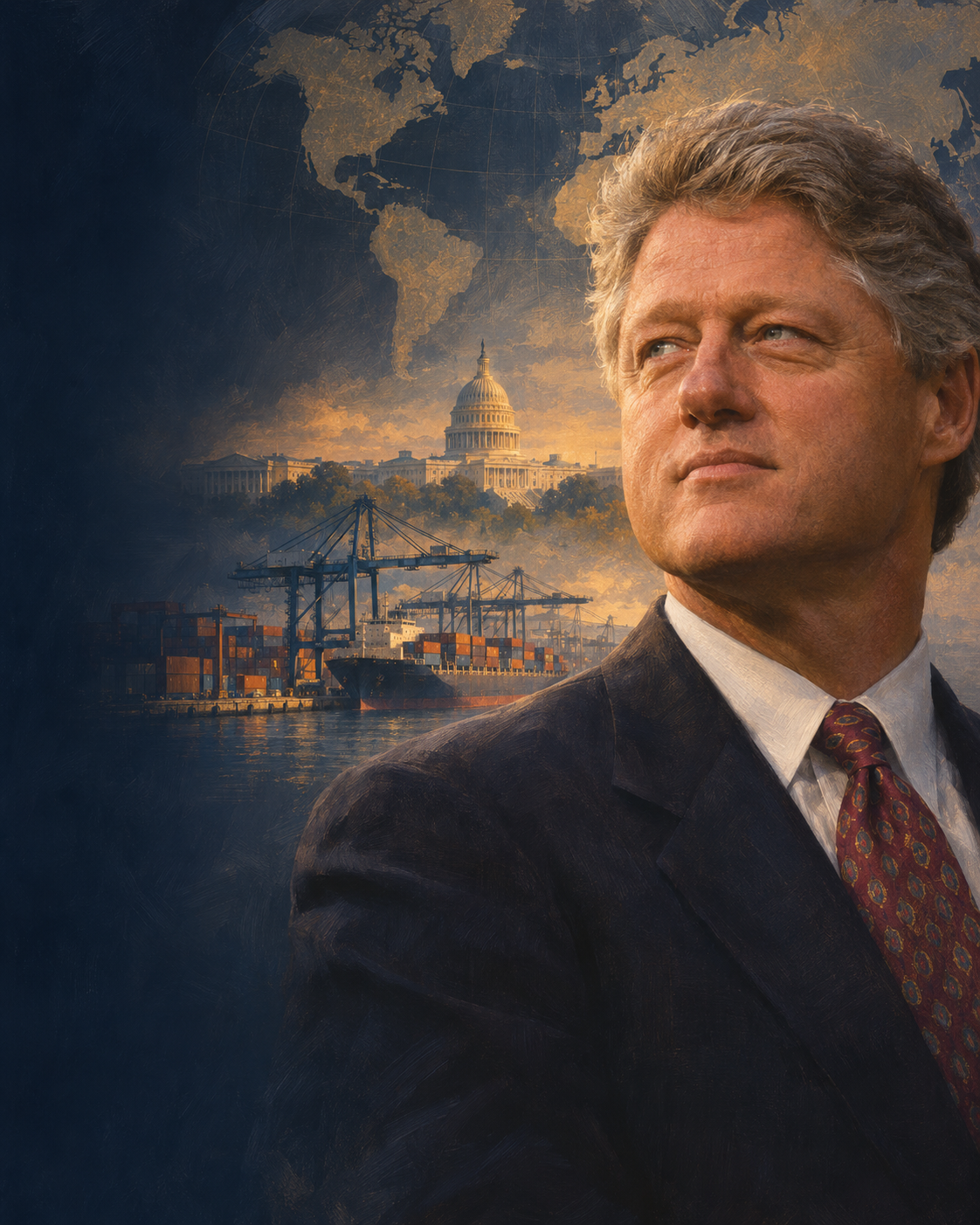
JANUARY 20, 1993 — JANUARY 20, 2001
Could a trade strategy reach people?
Bill Clinton took office with a North American agreement signed but not yet effective, a world trade round close to completion, and a post-Cold War debate over what economic security meant. He made export promotion a presidential priority. He also made a wager: that wider exchange could support prosperity and, often, political openness. The results need more than a count of agreements.
George H. W. Bush had negotiated and signed NAFTA and helped build the Trade Promotion Coordinating Committee. Clinton and Congress supplied the implementing law and supplemental labor and environmental arrangements; NAFTA took effect in 1994. The Uruguay Round likewise began under Reagan, advanced under Bush and concluded under Clinton before the World Trade Organization began in 1995. Inheriting machinery did not make Clinton's choices automatic. He decided how to use it and whom to send.
In a November 1993 address, Clinton said, We've got to have more customers for our products and services.
In the same speech he acknowledged workers' anxiety and promised skills and security at home. That pairing—export ambition and a contested promise to share its gains—runs through this presidency. This profile weighs his proposals against laws, transactions, partners' decisions and the people who bore the costs.
THE PEOPLE AND THE MACHINERY
Ron Brown gave the strategy a face.
The 1992 Export Enhancement Act required a governmentwide export plan. Commerce Secretary Ronald H. Brown chaired the coordinating committee, and Clinton unveiled its first Toward a National Export Strategy in September 1993. Clinton's Executive Order 12870 assigned coordination duties. Export assistance centers, finance, advocacy, export-control changes and a stronger commercial role for embassies were proposed as a system, not merely a collection of trips. A 1996 GAO review recorded operating assistance centers and an Advocacy Center, while questioning whether the strategy had measurable priorities and a unified budget.
One transaction shows the human mechanics. In February 1994, Saudi Arabia chose Boeing and McDonnell Douglas for a civil-aircraft order announced at nearly $6 billion, with Export–Import Bank financing. Clinton credited Brown, Secretary of State Warren Christopher and Transportation Secretary Federico Peña for visits to Riyadh and said embassies had become more active in commercial work. He also thanked King Fahd, Prince Bandar and the companies' workers. Saudi procurement was a Saudi decision; the announced order and anticipated U.S. jobs are not an independently audited final employment count. It is a concrete example of his approach: presidential access, cabinet advocacy, financing and a company bid converging. Clinton put it plainly: I don't mind asking for the business.
Brown and 34 others died when their trade-delegation aircraft crashed near Dubrovnik, Croatia, on April 3, 1996. The people lost deserve remembrance beyond the contracts their mission pursued. Read Brown's dedicated feature, including Christopher C. Herring's personal account of meeting him. After Brown, Commerce, USTR, State, trade specialists, firms and local partners continued the work; no single official owned the whole network. Secretary of State Madeleine Albright told Congress in 1998 that embassies should help American firms, while the administration also pressed for intellectual-property standards and core labor rights. The United States signed the Uruguay Round Final Act in 1994 through USTR Mickey Kantor, and the WTO began in 1995. Yet Clinton could not renew fast-track negotiating authority in the late 1990s, and the 1999 Seattle ministerial failed to launch a new round amid public protest and government disagreement. A completed rulebook was a platform for disputes and bargaining, not proof of a consensus over whose interests trade rules served.
FOUR REGIONAL READINGS
Four regions.
People on both sides of policy.
The chapters distinguish a U.S. initiative from another country's decision, and a law from its later effects. Country links lead to present-day Commercial Diplomacy Index research; they are not Clinton-era scores or evidence that a policy caused a modern result.
A partnership proposed.
On whose conditions?
Clinton brought trade missions, democracy assistance, debt relief and a new preference law to Africa. Mandela, Mbeki, Obasanjo and many others set their own terms—and the failure in Rwanda cannot be edited out of this account.
South Africa: listen before opening a market
Bush had lifted most U.S. anti-apartheid economic sanctions in 1991 over Nelson Mandela's objection about timing. In September 1993 Mandela himself called for the remaining sanctions to end as South Africa moved toward a transitional government. Clinton welcomed that judgment and asked Ron Brown to lead a trade and investment mission, particularly to connect with the Black private sector. Congress enacted a democratic transition support law. South Africans then elected Mandela in 1994. Clinton's later three-year assistance pledge was an announced commitment, not an independently verified disbursement ledger.
Mandela did not become a supporting character in an American trade story. At their 1998 Cape Town press conference, he objected to the proposed African trade bill's conditions, saying, To us, it is not acceptable.
Deputy President Thabo Mbeki had carried South Africa's concerns. Clinton defended incentives tied to reform. Their friendship and cooperation were real, as was disagreement over who should define eligibility and pace. Mandela also refused to discard South Africa's past allies merely because Washington disliked them.
AGOA, debt and Nigerian agency
Clinton's six-country 1998 Africa journey elevated trade and investment as presidential business, while African officials and companies described their own priorities. Congress passed, and Clinton signed in May 2000, the African Growth and Opportunity Act as part of the Trade and Development Act. It created eligibility-based preferences, assistance and a U.S.–Africa trade forum—not an Africa-wide free-trade agreement. The statutory conditions and initial beneficiary designations show an operating framework; subsequent export outcomes belong to later evidence and decisions by African businesses and governments.
Nigeria illustrates another kind of transition. Clinton used visa restrictions against officials obstructing democracy after the annulled 1993 election. Nigerians and their leaders made the eventual transition after military rule; the U.S. offered election assistance. In 2000, Clinton and President Olusegun Obasanjo discussed an Open Skies arrangement, direct flights and Nigeria's West African peacekeeping. Obasanjo spoke for Nigeria's own regional commitments. That exchange is commercial diplomacy carried by a partner, not bestowed on it.
Debt relief was multilateral and conditional. Clinton backed the enhanced HIPC effort, and Congress later appropriated funds; a November 2000 White House account identified countries qualifying for relief and a proposed U.S. bilateral cancellation, not proof that all proposed debt had been cancelled. Clinton's May 2000 HIV/AIDS medicines order restrained U.S. trade action against qualifying sub-Saharan access policies consistent with trade obligations. This was a policy opening, not a claim that medicines reached everyone who needed them.
Rwanda and Sudan: the limits of the promise
At Kigali in 1998, Clinton acknowledged the U.S. failure during the 1994 genocide against Tutsi: We did not act quickly enough after the killing began.
He also rejected the idea that it was merely an ancient tribal quarrel. Recognition mattered, but it did not reverse the failure to intervene. In Sudan, Clinton imposed economic sanctions, then ordered an August 1998 missile strike that destroyed the al-Shifa factory after the U.S. embassy bombings in East Africa. His chemical-weapons justification was contested at the time; Human Rights Watch urged independent inspection and raised the loss of pharmaceutical production. A history of commercial diplomacy must count health, civilian protection and uncertain evidence alongside access.
Assessment: Clinton made Africa more visible in U.S. trade policy and responded to South Africa's democratic opening. AGOA and debt tools created channels, but their terms were contested. Mandela and Obasanjo acted for their own countries; Rwanda and Sudan reveal grave limits to a narrative of benevolent economic engagement.
Opening doors.
Holding some closed.
Clinton sought Asian markets and built a Pacific leaders' forum, while China, Korea, India and Middle Eastern partners made choices that tested his belief in exchange as a source of political change.
China: a reversal in the human-rights bargain
Clinton's May 1993 order conditioned China's next most-favored-nation renewal on significant human-rights progress. In May 1994 he said China had not made overall significant progress, yet renewed treatment and delinked human rights from the annual trade decision. He kept targeted sanctions and argued that broad engagement might change China more effectively than isolation. It was continuity with Bush's preference for contact, but a reversal of Clinton's own stated condition. Chinese democracy advocates did not receive the protection that an open market was supposed to help bring about.
Charlene Barshefsky and Chinese negotiators reached a bilateral WTO-accession bargain in November 1999. Clinton then pressed Congress for permanent normal trade relations and signed Public Law 106-286 in October 2000. He predicted that China's WTO participation would widen economic and political openness. The law's operation was contingent on accession; China joined the WTO in December 2001, after Clinton left office, and permanent treatment became effective under George W. Bush in 2002. Neither a signed U.S. law nor a prediction is evidence that human-rights goals were achieved.
Japan and the Pacific: more than a U.S. market map
Clinton and Japanese Prime Minister Kiichi Miyazawa announced a 1993 economic framework that asked both countries to change: Japan on access, the U.S. on deficits and competitiveness. The 1995 auto dispute came close to retaliation, but a negotiated arrangement preceded the threatened sanctions. Prospective dealer and parts access were not a count of final sales. Clinton hosted APEC's first leaders' meeting at Blake Island in 1993; the forum itself had begun with a 1989 Australian proposal. Indonesian President Suharto helped shape the 1994 Bogor goals, aspirations for future open trade rather than a completed free-trade zone.
The 1997–98 Asian financial crisis exposed the fragility beneath that ambition. South Korea sought IMF assistance; newly elected President Kim Dae-jung led politically difficult reform and pushed his own North–South diplomacy. Clinton offered U.S. export credit support and discussed economic cooperation, but a credit offer was not a record of completed exports. In Indonesia, social and banking disruption was severe; Indonesians drove the 1998 political transition after Suharto resigned. APEC's optimistic declaration had not insulated them from crisis or authoritarian rule.
India's government conducted nuclear tests in 1998 and Clinton imposed statutory sanctions. By 2000 he and Prime Minister Atal Bihari Vajpayee set out a joint vision for economic and strategic dialogue, after some sanctions were waived. It was a new conversation, not a settled nuclear disagreement or a completed trade treaty. The 1994 U.S.–North Korea Agreed Framework likewise exchanged a reactor freeze and energy arrangements for staged commitments; full nuclear accounting was deferred, and the framework did not permanently settle the issue. Korean governments and voters were participants in these choices, not scenery.
Saudi Arabia and the Middle East: a sale, a process, no final peace
The Saudi aircraft decision showed what cabinet advocacy could do for U.S. manufacturers, while the Saudi government chose its supplier. In Israel–Palestinian diplomacy, Clinton hosted the 1993 Oslo signing and later facilitated negotiations, but Israelis and Palestinians negotiated the declaration through Norway. The 1994 Israel–Jordan treaty belonged to those two governments. Clinton signed a Jordan trade agreement in 2000; it took effect after he left office. In Gaza in 1998, he acknowledged scarce jobs and restrictions on movement and goods. The 2000 Camp David summit did not produce a final settlement. Market access could not substitute for sovereignty, security and negotiated rights.
Sanctions and military strikes against Iraq continued after the Gulf War. The UN's oil-for-food system began operating during Clinton's term, but a 1999 UN humanitarian panel described infrastructure damage, prolonged sanctions and shortcomings in aid and Iraqi distribution. The causes of civilian distress were not captured by one administration's blame or one oil export rule. Economic opportunity was never the only test of a regional policy.
Assessment: Clinton turned Asia-Pacific commerce into regular summit business and backed concrete deals, yet his China decision subordinated his own rights condition to engagement. Japanese bargaining, South Korean reform, Indian choices, Indonesian protest and Saudi procurement show partner agency. His predictions about political liberalization require separate evidence from his trade achievements.
A common market vision.
Unequal realities.
Clinton completed a global trade round and worked with Europe on investment, peace and security. Russia's crisis, Balkan destruction and Northern Ireland's negotiations remind us that rules need institutions and trust on the ground.
WTO rules and the transatlantic partnership
The Uruguay Round was launched under Reagan, advanced under Bush and completed in December 1993 under Clinton. Mickey Kantor signed the Marrakesh Final Act for the United States in April 1994. Congress approved the implementing law that year; WTO rules entered into force in January 1995. Europe was a negotiating partner and an economic competitor. Clinton, Spanish Prime Minister Felipe González for the EU Council and European Commission President Jacques Santer signed the New Transatlantic Agenda in 1995, building on Bush's 1990 declaration. It offered a program of consultation on trade, investment, democracy and common challenges, not a U.S.–EU free-trade treaty.
Rules made disputes more structured, not obsolete. U.S. complaints about Europe's banana-import regime and hormone-treated beef restrictions produced WTO rulings and retaliation authorizations in 1999. European governments defended their own regulatory choices and preferences, including arrangements that affected African, Caribbean and Pacific suppliers. The friction is part of a realistic account of allied commercial diplomacy.
Russia and NATO: integration with tension
Clinton and Boris Yeltsin pursued a 1997 joint economic initiative involving investment, finance and Russian integration into global institutions. These were offers and mechanisms, not evidence that reform had delivered broad prosperity. Clinton himself warned Moscow students, Economic reform must not be an excuse for the privileged and the strong to prey upon the weak.
A GAO assessment found mixed U.S. assistance results, and Russia's 1998 financial crisis interrupted the optimistic trajectory. The country's political and economic choices belonged to Russians, including many who paid for rapid change.
Poland, Hungary and the Czech Republic joined NATO in March 1999. Clinton linked democratic and market reform to security, but NATO was a security alliance, not an economic union. Russia opposed enlargement even as the 1997 NATO–Russia Founding Act opened consultation. Clinton's joint statement with Yeltsin acknowledged the disagreement. A relationship can contain cooperation and strategic loss of trust at once.
From Northern Ireland to the Balkans: investment after conflict
In Northern Ireland, Commerce Secretary Ron Brown was sent to an investment conference and helped plan the White House's 1995 trade-and-investment gathering. Clinton framed jobs and fair employment as ways to support reconciliation. The 1998 Belfast/Good Friday Agreement was the work of Northern Irish parties and the British and Irish governments, with George Mitchell facilitating and Clinton supporting. Investment did not write the peace agreement; it helped offer a reason to sustain it.
Clinton supported the 1995 Dayton-Paris peace agreement and joint U.S.–European reconstruction efforts. The people of Bosnia had to rebuild lives and institutions; donor pledges and estimated needs were not delivered homes. In Kosovo, NATO's 1999 campaign preceded UN Security Council Resolution 1244, which then authorized an international civil and security presence. The ICTY Prosecutor's review recorded civilian deaths from NATO bombing while recommending no investigation. Clinton's postwar address proposed humanitarian support and conditions on Serbian reconstruction. The case requires both the case for protecting people and the harm inflicted by force.
Assessment: Clinton helped complete the WTO settlement and used commerce as part of transatlantic and peace diplomacy. EU negotiators, Russian citizens and Northern Ireland's parties did not simply follow an American script. Russian economic disruption and Balkan civilian losses constrain any claim of a frictionless victory.
North American rules.
Hemispheric questions.
Clinton implemented NAFTA, promoted a broader free-trade area and preserved selective sanctions. Mexico's crisis, Caribbean migration and Colombia's conflict show why an agreement cannot stand in for a region's lived experience.
NAFTA: one president signed, another implemented
Bush, Carlos Salinas and Brian Mulroney signed NAFTA in December 1992. Clinton negotiated supplemental labor and environmental arrangements, signed the congressional implementing law in December 1993, and the agreement took effect January 1, 1994. Mexican and Canadian leaders negotiated for their own interests. Clinton's projected U.S. jobs gains were political forecasts; GAO later found competing job estimates unreliable and difficult to separate from exchange rates and other changes. Labor and environmental side mechanisms allowed complaints but did not guarantee that every workplace or community improved.
Mexico's 1994–95 peso crisis was not a simple verdict on NAFTA. Clinton authorized a U.S. support arrangement of up to $20 billion alongside multilateral help, secured in part by oil revenues. Mexico actually drew $13.5 billion in U.S. loans and, under President Ernesto Zedillo, repaid ahead of schedule; this is not a claim that $20 billion was spent or that the crisis caused no hardship. A GAO account described deep recession and multiple political and financial causes. Indigenous and labor voices, including the 1994 Chiapas uprising, challenged the claim that gains would be shared automatically; one cannot assign the uprising a single cause from the treaty's effective date.
From Miami to Panama: proposals and inherited commitments
At the 1994 Miami summit, hemispheric leaders set a goal for a Free Trade Area of the Americas by 2005. Formal talks began at Santiago in 1998, but there was no completed hemispheric FTA in Clinton's term. In 2000 Clinton and Chilean President Ricardo Lagos announced bilateral negotiations; the U.S.–Chile agreement was concluded and entered into force under George W. Bush. The 2000 Trade and Development Act also expanded Caribbean trade preferences with eligibility conditions. These were distinct routes, not one uniform open market.
The Panama Canal transfer on December 31, 1999 fulfilled the 1977 Carter-era treaties. Clinton presided over the final U.S. step; Panama gained operation and sovereignty under a settlement negotiated earlier. Recognizing this continuity is essential to a presidential timeline. An inherited obligation can be honored without treating its origin as a later president's invention.
Haiti, Cuba and Colombia: boundaries on the promise
Clinton initially continued the direct return of Haitian boat migrants established under Bush, then in 1994 acknowledged dangers to refugees and announced offshore screening. Following a UN authorization, a U.S.-led force helped restore the elected President Jean-Bertrand Aristide that October. Haitian voters had made the democratic choice; migration treatment is part of the American record too. Clinton signed the 1996 Helms–Burton/LIBERTAD Act tightening the Cuba embargo, after his administration had objected to some restrictions on executive flexibility. He repeatedly suspended a provision allowing private lawsuits over expropriated property and later allowed limited flights, remittances and exchanges. The embargo was not an absolute bar on all humanitarian contact; it was also not normalization.
Colombia's President Andrés Pastrana proposed Plan Colombia for his country's crisis. Clinton asked Congress for a roughly $1.3 billion regional package in 2000, covering security, anti-drug efforts and some human-rights and development support; it was not all a cash transfer to Colombia. He later used a national-security waiver to bypass statutory human-rights certification conditions. That choice put security ahead of an accountability safeguard. The consequences for Colombian communities, and the program's later outcomes, require their own evidence beyond the 2000 appropriation.
Assessment: Clinton implemented NAFTA, managed a real Mexican financial rescue and advanced trade preferences and negotiations. The hemisphere did not become one market on the promised timetable. Mexico's recession, Haitian asylum policy, Cuban restrictions and Colombia's rights waiver expose selective openness and the gap between an agreement and broad public benefit.
THE YEARS IN OFFICE
Rules, relationships, reversals.
- The export strategy takes shape.
Brown chairs the national export plan; Clinton implements NAFTA and hosts APEC leaders. The Uruguay Round is completed, and WTO agreements are signed. Mandela calls for remaining South Africa sanctions to end. Clinton imposes, then abandons, his annual China trade-and-rights condition. The genocide against Tutsi unfolds in Rwanda without a timely U.S. response.
- A new trade system and a personal loss.
The WTO begins. Clinton backs a Mexico rescue, signs the New Transatlantic Agenda, and supports Northern Ireland investment and the Bosnia peace process. Ron Brown and 34 others die on a trade mission in April 1996. The Cuba LIBERTAD law tightens restrictions.
- Growth meets crisis and criticism.
The Asian financial crisis hits. Clinton visits Africa, admits U.S. failure at Kigali and hears Mandela's objections to trade conditionality. The FTAA process formally launches; Northern Ireland's parties reach the Good Friday Agreement. The U.S. strikes Sudan's al-Shifa factory on contested evidence.
- Institutions outlast the term.
Clinton supports NATO enlargement and the Panama Canal transfer takes effect. Congress enacts AGOA and Caribbean preferences and a China PNTR law contingent on WTO entry. Plan Colombia receives U.S. support under a rights waiver. China joins the WTO in December 2001 after Clinton has left office.
THE EDITORIAL ASSESSMENT
He made commerce a mission.
The world answered back.
Clinton's commercial diplomacy combined a governmentwide export strategy, visible cabinet advocacy, the WTO's start, NAFTA's implementation and new African and Caribbean preferences. Ron Brown gave that effort a human presence, and the Saudi aircraft case shows how an embassy, ministers, financing, companies and a foreign buyer could meet around a transaction. The presidency advanced relationships as well as rules.
The other side of the ledger matters just as much. He reversed his own rights condition for China, supported trade preferences whose conditions Mandela contested, failed to act in time in Rwanda, pursued a Sudan strike on disputed evidence and waived a Colombia rights safeguard. Mexico's crisis and Russia's dislocation showed how fragile promised benefits could be. Clinton's economic optimism is a historical claim to examine against outcomes and the agency of partners, workers and communities—not a conclusion the magazine must adopt.
Evidence and editorial method
This profile links presidential statements and orders, enacted law, GAO audits, WTO and UN records, and the words of international counterparts. A proposal, signed law, effective rule, financing offer, actual loan and long-run outcome are different forms of evidence. Some contemporary government statements projected contracts or jobs; those figures are identified as claims unless independently substantiated. The Office of the Historian's 1993–2000 chapter is retired and no longer maintained, so direct records bear the specific claims here.
Links to Commercial Diplomacy Index country pages give current geographic context, not historical index scores or causal proof. The hero portrait is an original editorial illustration, not a photograph of a documented meeting. Brown's own feature supplies a distinct biography and Christopher Herring's recollection.