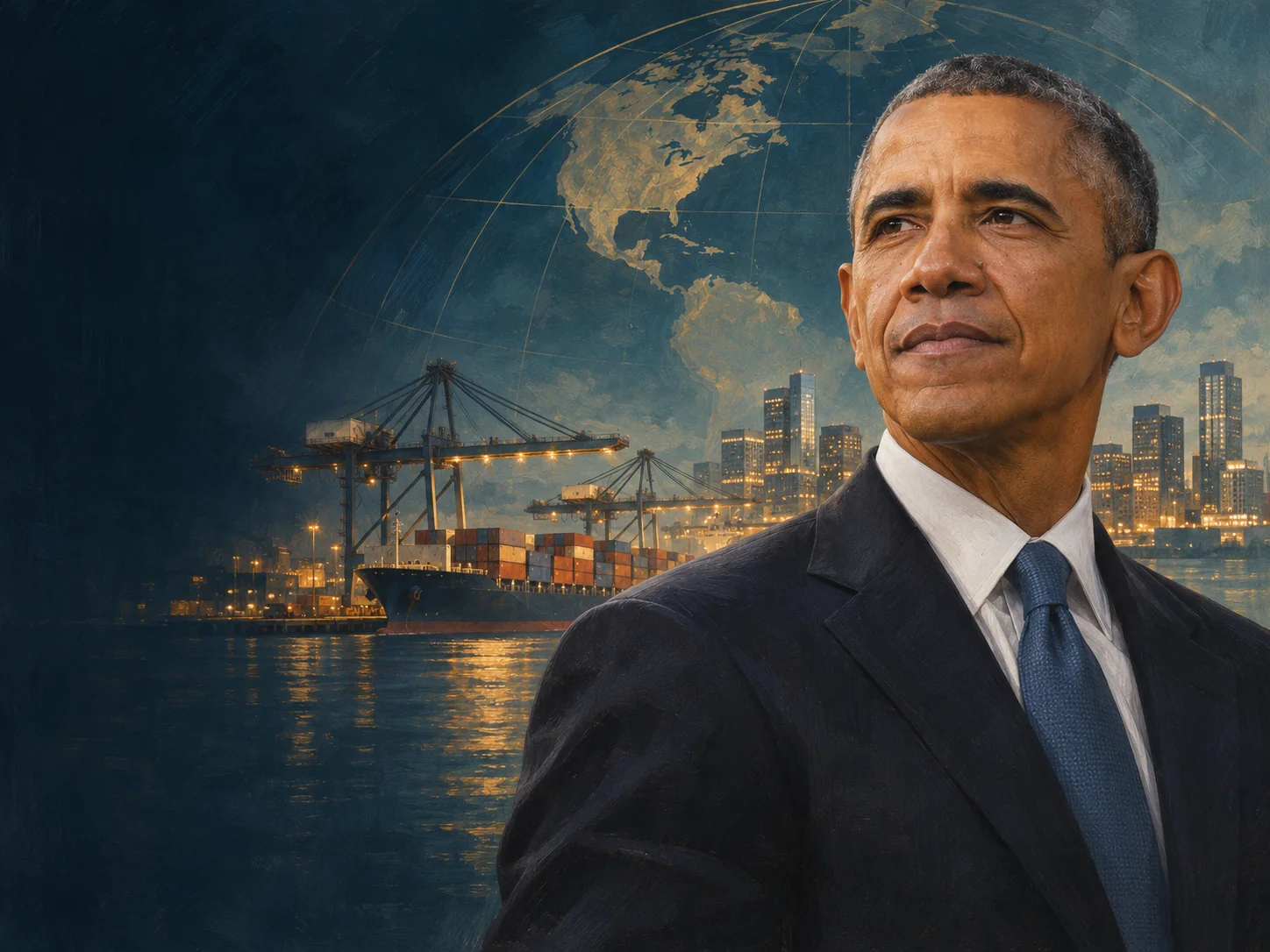
JANUARY 20, 2009 — JANUARY 20, 2017
Can foreign policy reach a hometown?
Barack Obama took office during a financial crisis and made a domestic argument for work overseas: a manufacturer selling to another country, or an investor opening a plant in an American town, could support jobs at home. His administration built a more explicit bridge among embassies, export agencies, states and local economic-development leaders. But an export target is not an export sale, and a business announcement is not a completed investment.
The 2010 National Export Initiative order organized a government-wide push around export promotion, financing, removal of trade barriers and commercial advocacy. Obama called for doubling exports over five years; that was a policy goal, not a result established by the order. In 2011 his SelectUSA order made the Commerce Department a federal point of contact for investment into the United States. States, cities and regions still competed and made their own case to investors.
THE PEOPLE AND THE MACHINERY
Jobs diplomacy had many hands.
Secretary of State Hillary Clinton called the approach “Jobs Diplomacy” in 2012: overseas missions were to help U.S. businesses find customers while encouraging foreign firms to invest in the United States. Ambassadors, commercial officers, economic officers and locally engaged embassy staff supplied contacts and judgment. Commerce’s U.S. Commercial Service, the Export-Import Bank, the Small Business Administration and USTR had different roles. Clinton and Commerce Secretary John Bryson described closer coordination, including co-location and cross-training where useful.
Commerce Secretaries Gary Locke and Penny Pritzker led at different points; USTRs Ron Kirk and Michael Froman negotiated with foreign counterparts. State’s economic leaders, including Robert Hormats and later Catherine Novelli, worked across diplomatic posts. Chambers of commerce, small firms, workers, state agencies and local development organizations had practical stakes. The State Department described partnerships with chambers and small businesses; its account of outreach should be read as an account of agency activity, not proof of a job in every participating community.
A separate 2012 executive order created an interagency task force for commercial advocacy on major foreign projects. The government could help an eligible American bidder receive a fair hearing. It could not promise a foreign government’s contract award or erase competing bids.
FOUR REGIONAL READINGS
Four regions.
More than one kind of deal.
These chapters separate an announced initiative from financing and implementation, a signed pact from one in force, and a U.S. position from another country’s decision. They are historical readings, not present-day index scores.
Partnerships at scale.
Results on the ground.
The U.S.–Africa Leaders Summit put African leaders and businesses at the center of a high-profile commercial conversation. It also exposed the distance between a commitment and a completed project.
A summit of governments and firms
Obama convened the U.S.–Africa Leaders Summit in Washington in 2014. African heads of state brought their own development priorities; American and African firms examined trade and investment. State officials reported more than $33 billion in public and private commitments associated with the summit. Commitments include intended financing, procurement and investment at different stages. They cannot be equated with completed spending or measured jobs without later evidence.
Young leaders as partners
Obama launched the Young African Leaders Initiative (YALI) in 2010. In South Africa in 2013, he announced its Washington Fellowship; the first class of 500 young African leaders came to U.S. universities in 2014 for six weeks of leadership training and networking. At a July 2014 town hall, he renamed it the Mandela Washington Fellowship in honor of Nelson Mandela. Fellows worked in business and entrepreneurship, civic leadership, and public management; follow-on mentoring, professional placements and opportunities in Africa were part of the design. The participants were leaders shaping their own communities, not a U.S. export statistic. This people-to-people investment belongs beside the summit and Power Africa as a relationship-building strand of diplomacy, while claims about its long-run economic effects require separate evidence.
Power Africa and trade access
Power Africa, launched in 2013, coordinated U.S. agencies, private capital and African partners around electricity access. An announced megawatt target, a financing commitment, a signed power agreement and electricity delivered to households are separate milestones. African utilities, regulators, entrepreneurs and communities shaped whether projects worked. The initiative was also an energy-development effort; it cannot be counted solely as an export win.
The African Growth and Opportunity Act began under Clinton and was extended under Bush. Congress renewed its preference framework in 2015, and Obama signed the legislation. Preferences could help eligible exports reach the U.S. market, but eligibility rules and differences among African economies constrained who benefited. The administration’s summit and trade agenda did not make African governments passive recipients of a U.S. plan.
Assessment: Obama elevated Africa in commercial diplomacy, including the Mandela Washington Fellowship’s investment in young leaders, and brought more institutions to the table. The record is strongest about convening and commitments; individual investments and electricity access need project-level evidence.
Agreements in force.
A Pacific pact without U.S. approval.
Some agreements inherited from Bush took effect. A larger Pacific negotiation reached signature but never became a U.S. trade agreement in force.
South Korea and the inherited agreements
The United States and South Korea signed their free-trade agreement in 2007 under George W. Bush. Obama and South Korean leaders resolved additional issues and obtained domestic approvals; it entered into force March 15, 2012. Obama also sought congressional approval for agreements with Colombia and Panama negotiated under Bush. Congress approved the implementing measures in 2011, and the agreements operated in 2012. Negotiation, signature, passage and implementation belong to different actors and dates.
The Trans-Pacific Partnership stopped short
USTR Michael Froman and ministers from eleven other countries signed the Trans-Pacific Partnership in February 2016. The proposed rules went beyond tariffs into services, intellectual property, labor and the environment. Supporters saw strategic and commercial access; critics challenged its labor, regulatory and distributional effects. Congress did not approve U.S. implementation before Obama left office, and the next administration withdrew the United States in January 2017. It would be inaccurate to describe the TPP as an Obama-era U.S. agreement in force.
China remained a central economic partner and competitor. Obama’s team used the WTO and bilateral discussions to press on market access and trade rules. Chinese officials, firms and workers made decisions within their own system; a U.S. trade case or diplomatic meeting did not guarantee policy change. The wider “rebalance” toward Asia included security and political relationships that cannot be measured by exports alone.
Assessment: The Korea agreement and two Latin American agreements took effect during Obama’s term after Bush-era signatures. TPP shows the opposite endpoint: a multilateral signature without U.S. domestic approval.
Negotiation across the Atlantic.
No finished transatlantic pact.
European partners and the United States explored an ambitious trade agreement while security and sanctions reshaped the relationship with Russia.
TTIP was a negotiation, not a treaty
Obama and European leaders launched talks on the Transatlantic Trade and Investment Partnership in 2013. Negotiators examined tariffs, regulatory cooperation, services and public concerns about standards. USTR’s record of negotiation rounds shows sustained work, but no TTIP agreement was concluded or put into force during Obama’s term. EU governments and institutions had their own mandates and public debates. A U.S. account of progress cannot substitute for a jointly ratified result.
Russia: commerce and a security rupture
Russia joined the WTO in 2012, after years of multilateral negotiations. Congress then established permanent normal trade relations for Russia through legislation Obama signed; the same law included the Magnitsky human-rights provisions. USTR welcomed the trade-status change. Following Russia’s actions in Ukraine in 2014, the United States and European partners imposed sanctions. Commercial access and security policy now pulled in sharply different directions; sanctions were coercive foreign policy, not an export-promotion program.
The WTO remained a venue for rules and disputes. Negotiating a bilateral pact or pressing a WTO case took many governments and institutions; neither a round of talks nor a favorable U.S. statement alone proves a durable commercial outcome.
Assessment: Transatlantic talks were substantial but unfinished. Russia’s trade integration and the later sanctions illustrate how an opening can be overtaken by a geopolitical rupture.
Neighbors, workers
and diplomatic openings.
Implementation of inherited agreements met labor concerns; Mexico built a standing dialogue, while Cuba reopened diplomatic channels under continuing legal limits.
Colombia and Panama: implementation with contested terms
The Colombia agreement took effect May 15, 2012, and Panama’s October 31, 2012. Colombia’s labor-rights concerns led the two governments to a labor action plan before U.S. passage; the existence of a plan did not prove full enforcement or safety for union organizers. Colombian and Panamanian institutions, employers and workers determined much of what followed.
Mexico as an ongoing economic relationship
Obama and Mexican President Enrique Peña Nieto proposed the U.S.–Mexico High-Level Economic Dialogue in 2013. Vice President Joe Biden, Commerce Secretary Penny Pritzker, USTR Michael Froman and Mexican counterparts launched it that September. Supply chains, infrastructure, education and regulatory issues required repeated cooperation rather than a one-day signing. The dialogue’s launch established a forum; specific results require separate assessment.
Cuba: embassies reopened, embargo remained
Obama and Cuban President Raúl Castro announced a move toward normalization in December 2014. The countries restored diplomatic relations and reopened embassies in July 2015. Travel and certain commercial rules eased through executive action, but the statutory U.S. embargo remained; Congress had not removed it. Cuban entrepreneurs, families and civil-society groups faced opportunities and restrictions shaped by both governments. A reopened embassy was a diplomatic milestone, not full commercial normalization or resolution of human-rights concerns.
Assessment: Obama implemented inherited Colombia and Panama agreements, built a practical forum with Mexico and changed the diplomatic relationship with Cuba. The effects on workers and communities cannot be inferred from ceremony or legal status alone.
THE YEARS IN OFFICE
From crisis to handoff.
- Recovery and export coordination.
Obama enters office amid the financial crisis. The National Export Initiative sets a government-wide export-promotion agenda and an ambitious five-year target.
- Investment and embassy work.
SelectUSA becomes a federal investment-promotion hub. Congress approves three previously signed trade agreements; Korea, Colombia and Panama take effect in 2012. State articulates Jobs Diplomacy.
- Regional dialogues and new openings.
Obama announces the Washington Fellowship in 2013; its inaugural 2014 class becomes the Mandela Washington Fellowship. Power Africa and the U.S.–Mexico High-Level Economic Dialogue launch; TTIP talks begin. Obama hosts the Africa leaders summit and announces a change in Cuba policy.
- Signature and limits.
AGOA is renewed; U.S. and Cuban embassies reopen. Twelve Pacific countries sign TPP in 2016, but the United States never puts it into force. TTIP remains unfinished.
THE EDITORIAL ASSESSMENT
He made the link explicit.
The outcome was local.
Obama connected foreign economic work to domestic employment more explicitly through the National Export Initiative, SelectUSA, Jobs Diplomacy and interagency commercial advocacy. These structures brought federal agencies closer to state and local development work and to businesses seeking overseas customers. Other governments, investors and communities still chose what to do with the opening.
Korea, Colombia and Panama were signed under Bush and took effect under Obama after further negotiation and U.S. and partner-country action. TPP was signed but never implemented by the United States; TTIP did not reach a completed agreement. The Mandela Washington Fellowship, Africa investment commitments, Power Africa goals and Cuba normalization each reached different stages and served different purposes. A fair measure of this presidency separates an institutional design from a claim of jobs, a pledged investment from money spent, and a relationship begun from a lasting result.
Evidence and editorial method
Primary presidential, State, Commerce and USTR records are linked beside the claims they support. They establish policy, dates and what officials reported; their estimates and pledges are not independent audits of jobs, investment or project outcomes. This account distinguishes inherited negotiations, legal implementation and subsequent policy changes. The regions are historical readings, not retrospective Commercial Diplomacy Index scores. The editorial portrait is generated art, not an archival photograph.
Read the presidential timeline for the neighboring administrations.