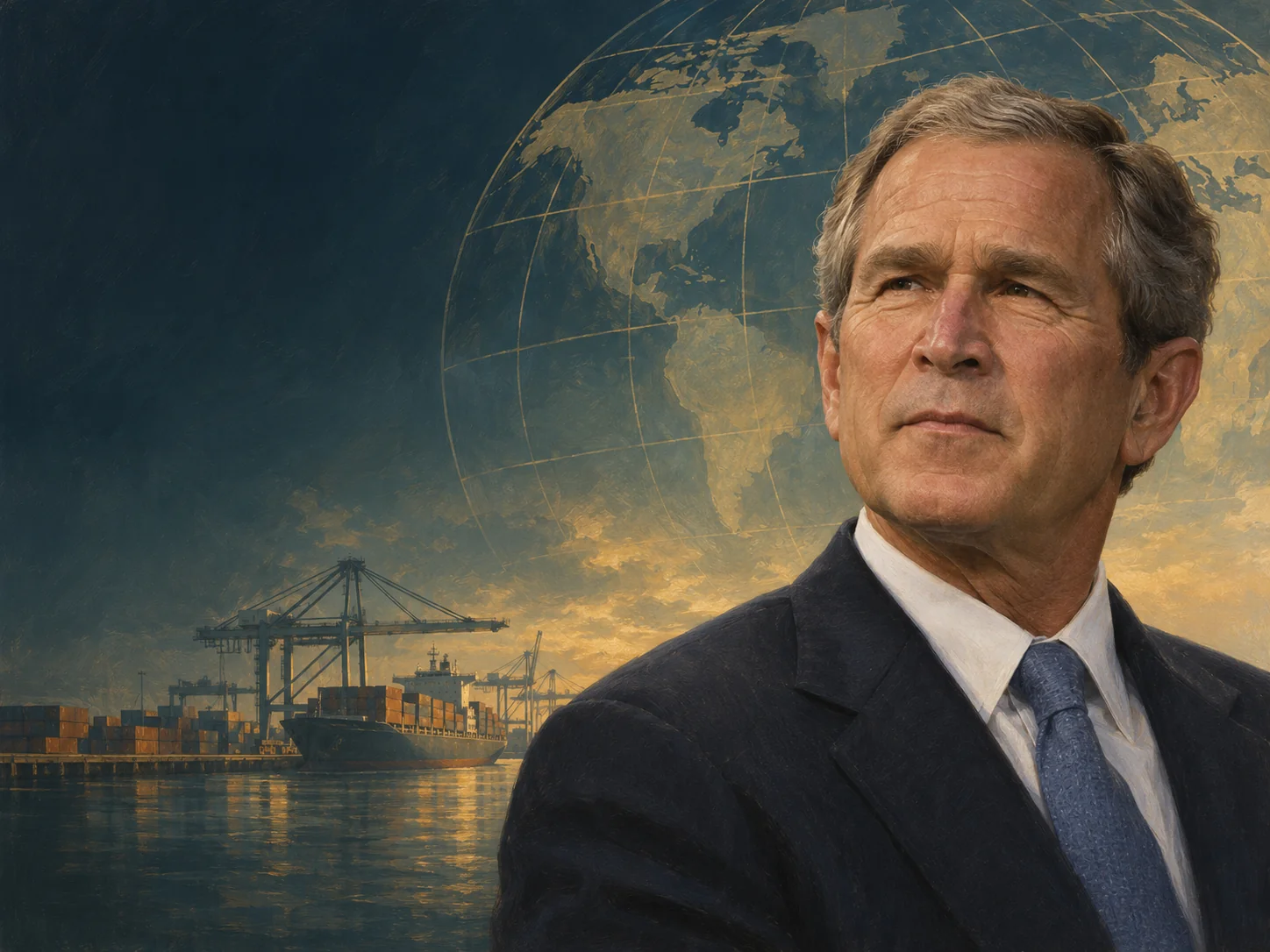
JANUARY 20, 2001 — JANUARY 20, 2009
Who makes an opening real?
George W. Bush inherited a trade system built through several presidencies, including Clinton’s export-promotion apparatus, the WTO and a law authorizing permanent normal trade relations with China. He placed market opening alongside national security, then pursued agreements with individual countries and regions. But a tariff schedule cannot itself build a trustworthy relationship or guarantee that its gains are broadly shared.
China entered the WTO on December 11, 2001, after the Clinton-era U.S. legislation and China’s own accession negotiations. Bush presided over entry, not the whole negotiation. Congress then restored trade promotion authority in the Trade Act of 2002. This gave partners a reason to negotiate knowing Congress would vote on implementing legislation without amendments; Congress still had to approve agreements. U.S. Trade Representative Robert Zoellick led the early negotiating agenda, followed by Rob Portman and Susan Schwab. State and Commerce worked with companies and embassies on the opportunities and disputes that agreements alone could not settle.
THE PEOPLE AND THE MACHINERY
The embassy was part of the deal.
In 2006 remarks, Under Secretary of State Josette Sheeran said Bush instructed new ambassadors to advocate personally for American companies seeking fair treatment abroad. State reported advocacy assistance to more than 150 firms in fiscal 2004 and attention to 110 posts without a Commerce Department presence. Those are agency-reported activity figures, not audited job creation or proof that every bid succeeded. Sheeran also described work with chambers of commerce on business visas and travel. Commerce specialists, USTR negotiators, diplomats, firms and foreign decision makers each occupied a different part of the chain.
The people behind this system matter. Sheeran led State’s economic-diplomacy portfolio; Zoellick, Portman and Schwab carried the trade negotiations; Secretary of State Condoleezza Rice oversaw a department that continued the Secretary of State’s Award for Corporate Excellence, begun in 1999, to highlight responsible business practice overseas. In 2006, State described training with the Business Council for International Understanding and consultations for outgoing ambassadors. Diplomacy depended on preparation, judgment and trust, not just access to a president.
The 2002 National Security Strategy explicitly connected free trade with national security and development. After September 11, security and visa controls also affected the movement of business travelers. These goals could reinforce one another or conflict; a presidential statement of principle was never the same as a country’s consent or a completed sale.
FOUR REGIONAL READINGS
Four regions.
Different kinds of opening.
Each chapter distinguishes a proposal from an enacted law, an agreement from its entry into force, and a U.S. objective from another government’s choice. These are historical readings, not present-day index scores.
Access and investment.
Health and human lives.
African governments and businesses used trade preferences for their own priorities. Bush extended a framework begun under Clinton while launching distinct development and health programs.
AGOA was extended, not invented
Clinton signed the African Growth and Opportunity Act in 2000. Bush signed the AGOA Acceleration Act in 2004, extending key preferences and adjusting apparel rules. In 2006 he approved further third-country fabric provisions. Eligibility depended on U.S. criteria; African producers and governments made their own investments and choices. Bush’s signing-ceremony export figures were his administration’s account, not evidence that all countries or workers gained equally.
Development and public health are related, distinct commitments
The Millennium Challenge Corporation, created in 2004, used eligibility criteria and country-designed compacts to pursue poverty reduction through growth. The approach made partner-country ownership part of the program, while U.S. selection rules remained powerful. In 2003 Bush announced PEPFAR, initially authorized as a five-year, $15 billion HIV/AIDS response. It belongs in a broad account of diplomatic relationships and people’s ability to participate in an economy, but it was a public-health program, not a trade agreement or export contract. Its proposed budget must not be confused with every dollar disbursed or every later health outcome.
Budget authority, a signed compact and payment on the ground were different stages. A 2008 GAO review found that MCC had selected 28 countries as eligible for compacts but signed agreements with 16 by March 2008. That gap does not by itself measure failure: it shows why a promise of assistance cannot be narrated as a completed project. The same distinction governs the administration’s PEPFAR targets and reported treatment figures.
Assessment: Bush preserved and expanded access through AGOA and made major development and health commitments. African agency, eligibility conditions and the difference between funding authority and results remain central to judging the legacy.
Strategic partners.
Different bargains.
China’s WTO entry, Asian bilateral agreements and Middle Eastern trade initiatives brought commerce into wider security and diplomatic relationships.
China entered a system already negotiated
China became a WTO member in December 2001, with Chinese officials committing to accession terms that had taken years to negotiate. Bush’s administration inherited the U.S. domestic approval enacted in 2000. Entry created enforceable rules and commercial possibilities; it did not settle later disputes about manufacturing, labor conditions, market access or national security. Treating a country’s later economic trajectory as the work of one American president would erase China’s own choices and a much longer international process.
Singapore, Australia and West Asian partners
Bush’s 2002 strategy named Singapore, Australia and Morocco as priorities. The U.S. agreements with Singapore and Chile were enacted in 2003. Negotiations with Australia led to an agreement effective January 1, 2005. Each partner negotiated as a sovereign government and weighed its own domestic interests. The U.S.–Jordan agreement entered into force in 2001, after having been signed under Clinton; it should not be treated as a Bush-originated negotiation. Morocco, Bahrain and Oman became parts of a wider Middle East trade agenda, while a proposed regionwide free-trade area was never completed during his presidency.
India and Vietnam: negotiations with other agendas
Bush and Indian Prime Minister Manmohan Singh set out a 2005 strategic partnership that included technology, energy and trade. The 2008 civilian nuclear agreement was signed by Condoleezza Rice and Indian External Affairs Minister Pranab Mukherjee after Indian, U.S. and international approvals. It opened a legal framework for civil cooperation; projected commercial opportunities were not completed reactor sales. India’s energy strategy and parliamentary debate were Indian decisions, and the special accommodation for a state outside the Nuclear Non-Proliferation Treaty was controversial.
Vietnam illustrates another handoff. A bilateral trade agreement signed under Clinton took effect under Bush. In a 2006 joint statement, Bush and President Nguyễn Minh Triết welcomed Vietnam’s path toward WTO membership and the prospect of permanent normal trade relations with the United States. Bush issued the trade-status proclamation after Congress acted. Vietnam’s own reforms and choices, including debates over rights, were not simply products of American diplomacy.
South Korea’s government signed an agreement with the Bush administration in June 2007. It entered into force in March 2012 after additional work under Obama and Korean domestic procedures. Signature and operation belong to different administrations and both countries.
Diplomatic advocacy had limits even among friendly governments. An ambassador could argue for an American bidder; the host government retained its procurement decision. Security policy after September 11 shaped regional relations, and the wars in Afghanistan and Iraq carried human and financial consequences far beyond any trade initiative. A trade profile cannot turn those conflicts into an uncomplicated market-opening story.
Assessment: Bush expanded a network of bilateral agreements in Asia and West Asia while China entered the WTO. The signatures represented negotiated relationships, not a single regionwide success or a guarantee of shared gains.
A global ambition.
No finished global round.
The administration argued for ambitious WTO liberalization, but negotiating partners, farm policy and domestic politics made a comprehensive settlement elusive.
The Doha gap between goal and agreement
The WTO launched the Doha Development Agenda in 2001. Bush supported reduced tariffs and subsidies and sought more open markets through the WTO as well as bilateral talks. European Union members, India, Brazil and other negotiators had interests of their own, particularly in agriculture, industrial tariffs and development. The USTR and Agriculture secretaries’ 2007 statement acknowledged a failure to reach consensus while presenting the U.S. position. That statement is one participant’s account of a multilateral impasse, not an impartial verdict on all parties.
Transatlantic skies and the 2008 crisis
Commerce crossed borders by air as well as sea. The United States and European Community signed an air transportation agreement in 2007, after years of talks, and it took effect March 30, 2008. The agreement widened routes that eligible U.S. and European airlines could serve. It was a bilateral achievement with European negotiators, not a WTO settlement or a guarantee of cheaper flights for every traveler.
When financial markets seized in 2008, Bush brought leaders to Washington for the first G20 summit of heads of government. Their November declaration urged cooperation, trade finance and resistance to new trade barriers. A collective declaration was a commitment to pursue action, not proof that the crisis was solved. The meeting also reminds us that the global commercial order depends on banks, credit and public confidence, not only tariffs.
European allies also differed from Washington on the Iraq war and other strategic questions. Their economic ties did not erase political disagreement. By 2008 there was no completed Doha trade agreement. Congress’s 2002 trade promotion authority had expired in 2007; the inability to conclude a global round cannot be credited or blamed solely on any one leader.
Assessment: Bush pursued global liberalization, but the WTO round remained unfinished. The distinction between an ambitious proposal and an agreed rule is fundamental to this history.
Neighboring economies.
National choices.
Chile and Central America show how negotiation, congressional action and different entry dates turned a presidential agenda into working agreements.
From a Clinton-era start to a Bush-era agreement
Clinton and Chilean President Ricardo Lagos announced U.S.–Chile negotiations in 2000. Bush’s USTR completed the work, and Bush signed implementing legislation in 2003. The agreement entered into force in 2004. At the same time, the U.S.–Singapore accord illustrated the administration’s willingness to pursue agreements outside its own hemisphere. A chronological account credits the earlier start, Chile’s negotiating role and the later implementation separately.
CAFTA-DR was phased in
Bush called for a Central American trade agreement and negotiations began in 2003. The initial Central American negotiation concluded in 2003; the Dominican Republic joined the wider arrangement. Congress approved the implementing law in 2005. According to USTR’s implementation record, entry into force began with El Salvador in March 2006, followed by Honduras, Nicaragua and Guatemala in 2006, the Dominican Republic in 2007, and Costa Rica in January 2009. The agreement contained rules on services, investment, procurement, labor and the environment as well as tariffs. Whether it benefited a particular worker, producer or community requires evidence beyond its legal start date.
Colombia and Panama reached agreements with the Bush administration, but implementation came later. Their politics and U.S. congressional debate outlasted Bush’s term. Concerns over violence against trade unionists and enforcement of labor rights figured in the Colombia debate; later GAO work documented the need for stronger monitoring and enforcement among several FTA partners. The later audit should be read as evidence about implementation, not as a contemporaneous judgment issued during Bush’s presidency. The broader Free Trade Area of the Americas envisioned in earlier years did not become a completed hemispheric agreement. Bush used bilateral and regional routes when a single hemispherewide settlement proved unavailable.
Assessment: The administration completed important negotiated frameworks, especially CAFTA-DR, but entry into force occurred country by country. Unfinished Colombia and Panama arrangements and a stalled hemispheric project show the limits of a signature count.
THE YEARS IN OFFICE
Authority, advocacy, handoffs.
- An inherited opening and a new negotiating mandate.
China enters the WTO after a long accession process. The U.S.–Jordan agreement takes effect. The WTO launches Doha. Bush signs the Trade Act of 2002 restoring trade promotion authority.
- Agreements and broader commitments.
Singapore and Chile agreements are enacted; negotiations with Central America advance. Bush announces PEPFAR, signs its authorizing law and extends AGOA. The Millennium Challenge Corporation begins.
- Implementation reaches embassies and partners.
Australia’s agreement takes effect, Congress approves CAFTA-DR and phased implementation starts. State describes ambassadors’ commercial advocacy and partnerships with Commerce and chambers.
- Some negotiations remain unfinished.
Trade promotion authority expires in 2007. Doha remains unresolved. Costa Rica implements CAFTA-DR in January 2009; Colombia, Panama and Korea agreements await action in later years. Bush hosts the first G20 leaders’ meeting amid the financial crisis.
THE EDITORIAL ASSESSMENT
He widened the toolkit.
The outcome depended on others.
Bush used renewed trade authority to negotiate across regions, pressed ambassadors to advocate for U.S. companies and extended parts of the AGOA framework. He also backed public-health and development institutions whose purpose extended beyond commerce. Negotiators, diplomats, partner governments, businesses and communities shaped whether any opening became useful.
His presidency did not complete the Doha Round or a hemispherewide trade area. Some agreements negotiated during his term entered into force only after he left office. India’s civilian nuclear pact and the U.S.–EU aviation agreement show that commercial diplomacy also used sector-specific frameworks, while the 2008 G20 gathering placed crisis coordination on the agenda. The effects of imports, exports, migration controls and military conflict cannot be reduced to the number of free-trade agreements. The most honest account recognizes practical access, contested distribution and the independent decisions of other countries.
Evidence and editorial method
This profile draws on presidential records, State and USTR statements, WTO membership dates and trade agreement implementation records. Administration statements establish what officials said or reported; they do not independently establish every projected job, final commercial result or long-run social benefit. AGOA predates this administration, the China accession process predates it, and some Bush-era agreements took effect under later presidents. The geographic chapters describe historical events and do not assign retrospective Commercial Diplomacy Index scores. A generated editorial portrait conveys the theme; it is not an archival photograph.
Primary records appear as links beside the relevant claims. Read the series timeline for neighboring administrations.