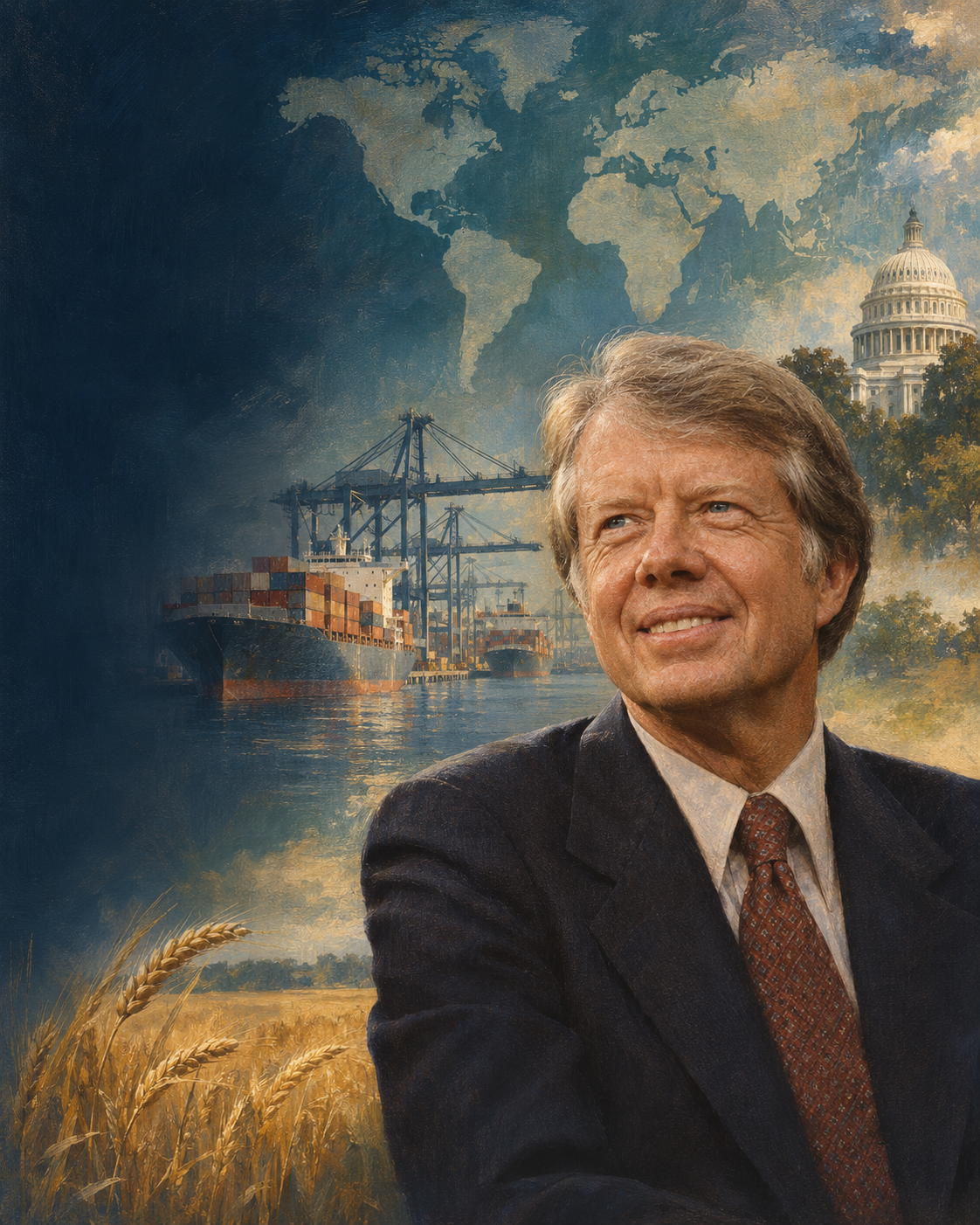
JANUARY 20, 1977 — JANUARY 20, 1981
When a principle becomes a policy, who gets the benefit?
Carter’s commercial-diplomacy record begins with a distinction: he did not invent every opening he completed, and he did not resolve every contradiction he identified.
He inherited the Ford administration’s trade-negotiating authority, an unfinished Tokyo Round, a path toward a Panama settlement and the still-incomplete China opening begun under Nixon. Carter put his own stamp on them. He reached a China normalization agreement, signed the Panama treaties, helped bring the Tokyo Round into U.S. law and reorganized the federal trade apparatus. These are distinct actions with different start dates, partners and consequences.
He also made human rights more central to American foreign policy. That claim must be tested against his choices about the Shah of Iran, Indonesia’s occupation of East Timor, the Marcos government, Mobutu’s Zaire and military relationships in Latin America and North Africa. The analysis below asks whom he worked with, what the other side wanted, what was actually agreed, and who was left out of a deal. “Commercial diplomacy” is our lens on those choices, not the name of a single Carter-era index.
THE INSTITUTIONAL CHOICE
Who would help an exporter find a buyer?
Carter’s September 1978 National Export Policy made export growth an explicit administration priority. It joined financing through the Export–Import Bank, assistance to small firms, market information and efforts to reduce barriers at home and abroad. He called increasing exports a major challenge
for business, labor and government. The policy cited greater Ex-Im lending authority and proposed new guarantees and spending; authorization and proposals are not proof that every dollar was lent or spent. In announcing it, he argued that small firms needed practical help finding customers and cautioned against weakening worker, environmental or human-rights standards for exports.
The Tokyo Round began under earlier presidents and operated under the Trade Act Ford signed. Carter’s negotiators concluded agreements in April 1979; he signed implementing legislation in July. The resulting rules addressed tariffs, subsidies, valuation, standards, government procurement and other barriers. A 1980 progress report dates the first tariff cuts and most codes to January 1980, while further tariff reductions were phased in. This was a delivered negotiation, not an overnight elimination of all barriers.
Then came Reorganization Plan No. 3 of 1979. It strengthened the U.S. Trade Representative’s lead in policy and negotiations and moved nonagricultural trade operations and overseas commercial representation toward Commerce; State retained foreign-policy advice. Carter’s diagnosis was blunt: The trade machinery we now have cannot do this job effectively.
Executive Order 12188 made most provisions effective January 2, 1980, but the specified State-to-Commerce overseas commercial-function transfer took effect April 1, 1980. Economic officers and ambassadors remained central diplomatic actors. The Commercial Service history traces the institutional result.
The same presidency showed that commercial authority could also close a door. After the Soviet invasion of Afghanistan, Carter restricted grain exports beyond the eight-million-ton annual commitment in Ford’s 1975 agreement and reviewed strategic-technology licenses. The security decision could impose costs on American farmers and firms too; a contemporaneous estimate is not a measured final loss.
FOUR REGIONAL READINGS
Four regions.
Many different partners.
Each chapter compares Carter’s stated principles with decisions, agreements and unfinished negotiations. The country links point to current research in the Commercial Diplomacy Index; today’s data cannot measure the 1970s.
Trade and self-rule.
Selective solidarity.
Carter promised a more ambitious African relationship. He built working channels with Nigeria and supported Zimbabwean majority rule, while strategic exceptions tested his human-rights language.
Nigeria: a partnership built in meetings, not a single oil sale
Carter told Nigeria’s elected President Shehu Shagari in 1980 that he had resolved to open a new diplomatic and trade effort in Africa. The relationship already had a deeper history. Olusegun Obasanjo’s 1977 visit pressed Washington to replace reassuring words with action. Carter went to Lagos in 1978, the first official state visit by a sitting U.S. president to sub-Saharan Africa. Their joint communiqué set working groups on trade and investment, technology, agriculture and education. Carter acknowledged that Nigeria supplied U.S. oil, but his Lagos address also linked prosperity to technology and development. A proposed development-fund contribution and an offer of engineering help were not, by themselves, completed projects.
There was follow-through beyond the photograph. A 1978 State report records a second round of high-level bilateral economic talks. An American energy team later visited Lagos to discuss LNG, though price and regulatory questions remained. By Shagari’s 1980 visit, the two governments had established a joint agricultural consultative committee. These meetings and institutions mattered; a proposed LNG arrangement should not be described as a delivered gas contract. Nigerian leaders were negotiating their own industrial and political interests, not merely receiving a U.S. program.
Zimbabwe and South Africa: a moral position with an outcome
Carter continued diplomacy begun under Ford and worked with Britain and African governments toward majority rule in Rhodesia. He resisted lifting sanctions prematurely in 1979. The Lancaster House settlement followed in December, and independent Zimbabwe emerged in April 1980. Credit belongs to Zimbabweans, British negotiators and neighboring African governments as well as the Carter administration; Ford-era efforts were part of the inherited path. The United States also expanded its ban on exports for South African military and police use in 1977, but this was not a comprehensive economic embargo on apartheid South Africa. Namibian independence negotiations remained unfinished when Carter left office.
The partners who exposed the exceptions
Carter’s government still backed Mobutu’s Zaire as a strategic and mineral partner. During the Shaba crisis he approved a limited military-fuel financing measure; an authorization ceiling is not a record of every shipment. After Liberia’s 1980 coup, he authorized covert advice and training to preserve a pro-Western alignment and U.S. facilities, while stating an aim of encouraging respect for human rights. Angola recognition was delayed amid Cold War and congressional pressures. These cases challenge any simple claim that a declared rights policy ended selective security support.
In North Africa, Carter’s letter to Algeria connected energy, technology, finance and students. Morocco shows a sharper conflict: his administration initially restricted arms for use in the Western Sahara conflict, then in 1979 approved a conditional liberalization for King Hassan II. Congressional critics warned about Sahrawi self-determination; authorization and deferred delivery must not be flattened into a claim that every aircraft arrived. The dispute remained unresolved. Commerce with partners and concern for people in contested territory did not automatically point in the same direction.
Assessment: Nigeria’s continuing economic dialogue and Zimbabwe’s transition were substantial advances. South African export restrictions were narrower than a total embargo, and Zaire, Liberia and Morocco reveal an administration still willing to privilege access or alignment. Carter’s record changed the conversation, but its standards were applied unevenly.
Recognition opened doors.
Alliances tested the promise.
China normalization was a genuine presidential result. Indonesia, Iran and the Philippines show why economic openings must be examined together with the people affected by security choices.
China: from Nixon’s opening to an operating relationship
Nixon opened the channel and Ford kept it alive. Carter and Chinese leaders completed diplomatic normalization effective January 1, 1979. Carter said the change would expand commercial and cultural relations while promising unofficial ties with Taiwan. The Taiwan Relations Act then supplied a legal framework for continuing unofficial commercial relations. Recognition was not the end of a negotiation: textiles, claims and tariff treatment remained contested.
People translated statecraft into trade. Robert Strauss led a 1979 mission with 23 American business leaders and met Deng Xiaoping and other officials; the briefing also recorded unsettled issues. A bilateral trade agreement was signed in July 1979 and, after required American procedures, entered into force February 1, 1980. This was a completed legal opening and an invitation to build actual business relationships, not proof that every firm found a buyer. Beijing and Taipei each had agency in the outcome.
Japan and Korea: allies with their own demands
Japan’s Prime Minister Takeo Fukuda and later Masayoshi Ohira were important counterparts in an alliance that also contained trade frictions. A 1978 U.S.–Japan understanding addressed trade and economic issues, while a Carter–Ohira consultative group brought private leaders into the economic dialogue. Neither mechanism made every agricultural or industrial dispute disappear. With South Korea’s Park Chung-hee, Carter pressed rights and security questions alongside trade. A 1979 communiqué referred to import liberalization, while Carter paused further U.S. combat-troop withdrawals after security reviews. Economic and military decisions were intertwined, not the same decision.
Indonesia and the Philippines: the difficult continuity
Ford had told Suharto that Washington would not press him on East Timor just before Indonesia’s invasion. Carter’s administration did not simply reverse course. A State Department cable accepted Indonesia’s incorporation while recognizing that Timorese self-determination had not been fulfilled and calling for greater humanitarian assistance and access for relief groups. In 1978 Vice President Mondale relayed a qualified approval in principle for aircraft sales, tying final action and financing to prisoner releases and access to East Timor. A diplomatic report of a promised release is not proof that all detainees were freed. These records are a severe test of whether human rights could discipline a strategically valued relationship.
Carter also maintained a relationship with Ferdinand Marcos’s Philippines while raising detainee concerns. His letter defending security assistance shows how Washington weighed bases and influence against repression. That a right was discussed did not mean it controlled the decision. The people living under allied governments belong in the commercial-diplomacy account as much as officials seeking access to a base or market.
Iran and the Middle East: a favored partner, then a rupture
In Tehran in December 1977, Carter toasted the Shah’s Iran as an island of stability
. The relationship combined oil, arms and regional security; U.S. officials also had serious internal-security and human-rights concerns. Revolution in 1979 overturned the partnership. After the seizure of the U.S. Embassy and American hostages, Carter froze Iranian government property. The reversal shows how brittle an economic relationship can be when a government is treated as the country’s only political voice.
Saudi leaders were strategic energy partners, not simply suppliers. An ambassador’s account of the F-15 sale intertwined oil, security and regional politics. Carter, Anwar Sadat and Menachem Begin achieved the 1979 Egypt–Israel peace treaty, whose provisions contemplated normal commercial relations and oil arrangements. Peace between those governments was a major result; Palestinian autonomy and wider regional peace remained unresolved. Following the Soviet invasion of Afghanistan, Carter’s 1980 State of the Union attached a stronger U.S. security doctrine to the Persian Gulf. Commerce and force were again part of the same strategic conversation.
South Asia added another turn: with India’s elected Morarji Desai, Carter pursued trade and development discussion while nuclear-fuel issues remained disputed. After Afghanistan, he sought a stronger relationship with Pakistan’s Zia amid refugee and security concerns. Pakistan rejected the proposed assistance package as presented; a request for alignment did not guarantee acceptance. The shift underscored how regional security could rearrange the hierarchy of favored partners.
Assessment: China normalization and its trade agreement were concrete advances, as was the Egyptian–Israeli treaty. The Indonesia, Marcos and Shah records show the gap between a rights principle and treatment of security partners. Carter’s changing alliances make sense only if the counterpart governments and affected communities are both visible.
Opening markets.
Closing a strategic door.
Ford’s summitry and trade talks became Carter’s agreements and implementing law. Industrial disputes and the Soviet invasion of Afghanistan then exposed the limits of openness.
Allies at the table, with real disagreements
Carter inherited the economic-summit forum and made reciprocal commitments a theme of the 1978 Bonn meeting. West Germany’s Helmut Schmidt and France’s Valéry Giscard d’Estaing were partners who negotiated their own interests, not instruments of U.S. policy. Carter acknowledged American oil use and European concerns while asking allies to follow through on energy and growth pledges. A summit statement is a promise to act, not a measured result for each target.
His 1978 letter to Giscard pressed for concessions on tariffs, agriculture, subsidies and dispute settlement, warning that failed talks could feed protectionism. Brzezinski’s message to Schmidt enclosed analysis of resistance from France and Britain and hopes for Schmidt’s help. The Tokyo Round’s April 1979 agreements and July implementing law were tangible; the 1980 U.S.–European steel dispute proved that reciprocal rules did not end every industry’s demand for protection.
The Soviet relationship: from détente to sanctions
Carter and Leonid Brezhnev signed SALT II in Vienna in 1979, continuing a negotiating relationship that had evolved under Nixon and Ford. The treaty was not ratified. The Soviet invasion of Afghanistan fundamentally changed Carter’s terms for commerce. In January 1980 he said nations could not continue to do business as usual with the Soviet Union
and restricted grain above Ford’s eight-million-ton annual commitment, reviewed strategic exports and deferred Senate action on the treaty. The restriction was not a total grain cutoff, and it exposed U.S. farmers to lost sales even as the administration sought to protect farm prices. Schmidt later told Carter that some U.S.-favored economic pressure rebounded on West Germany, whose Soviet trade was far larger relative to its economy. Allies did not uniformly accept Washington’s approach.
Carter maintained Jackson–Vanik emigration conditions on Soviet trade rather than claiming trade would automatically improve rights. At the same time, he sought to distinguish other Eastern European governments from Moscow. He recommended continued trade waivers for Romania and Hungary in 1979, citing humanitarian progress: Romania’s agreement originated in Ford’s term, while Hungary’s was signed in 1978. He publicly opposed outside intervention in Poland in December 1980. These were selective decisions, not a single all-or-nothing Eastern bloc policy.
Visits to Spain and Portugal in 1980 supported newer democracies and addressed trade, energy and economic cooperation. Their priorities were their own; Spain, for example, raised its trade imbalance. Carter’s support for democratic change should be assessed alongside what agreements actually delivered, rather than treating a state visit as a finished investment program.
Assessment: Carter brought an inherited trade negotiation into law and pressed summit partners to honor specific pledges. Steel frictions exposed competing domestic interests. Soviet aggression then led him to restrict commerce while preserving the limited Ford grain commitment and keeping openings to selected Eastern European partners. The turn was a strategic choice, not a collapse of all trade diplomacy.
Sovereignty as a promise.
Power in the details.
The Panama treaties were a historic negotiation completed on Carter’s watch. Neighboring governments, Caribbean institutions and human-rights disputes reveal what partnership required beyond a signature.
Panama: negotiating control and trust
In an April 1977 OAS address, Carter rejected a single formula for Latin America and spoke of sovereignty, human rights and development. He said, We will not act abroad in ways that we would not tolerate at home in our own country.
It was a demanding standard for a country with vast power in the hemisphere.
Carter and Omar Torrijos signed the Panama Canal treaties in September 1977. Carter then secured Senate consent against substantial domestic opposition. He explicitly credited negotiations across four administrations and Ford’s support. The new arrangements took effect October 1, 1979, beginning a transition rather than immediately transferring full canal operation; Panama’s full control arrived at the end of 1999. Carter argued that recognizing Panamanian sovereignty and keeping the waterway open served long-term hemispheric goodwill, trade, jobs and exports. He completed a negotiation others had begun, with Panama exercising decisive agency.
Mexico, Canada and Caribbean cooperation
Mexico’s José López Portillo sought respect as an equal partner, better access for manufactured exports and a gas price and terms his government could defend. A U.S. intelligence assessment describes those priorities. Carter’s 1979 joint communiqué described growth in Mexican goods under trade preferences while acknowledging restrictions. The later gas framework still needed commercial arrangements and approvals. With Canada’s Pierre Trudeau, Carter selected a cross-border Alaskan gas route; choosing a route was not completing a pipeline. Both neighbors could resist terms that did not meet their interests.
In the Caribbean, the Carter administration helped convene a World Bank-led Caribbean Group to coordinate development. A 1980 assessment reported work on agriculture, transport, tourism, exports and private investment as well as funding gaps. Carter invited universities, businesses, churches and citizens into the relationship. Venezuela’s Carlos Andrés Pérez was a democratic counterpart on oil and regional development. Carter also explored Cuba ties: a 1977 record describes a fisheries agreement, a preliminary maritime-boundary agreement and mutual Interests Sections. The embargo and formal diplomatic break remained. The Caribbean Basin Initiative legislation belongs to Reagan, not Carter.
Human rights: the closest partners were not exempt
Carter’s policy confronted the repression of Chile and Argentina, including some restrictions on aid and international lending, while trade and strategic calculations remained. An internal administration accounting shows how selective multilateral-bank opposition actually was. In a 1980 conversation, Carter acknowledged he had invited Augusto Pinochet to the Panama signing and described Chile, Argentina and Brazil as countries the United States wanted as friends, even while supporting sanctions in response to the Letelier and Moffitt murders. A 1978 Argentina memorandum recognized severe abuses but considered training and Export–Import Bank credits conditional on changes. Consideration is not proof of approval or disbursement.
Brazilian leaders objected to trade and nuclear-policy restrictions they considered unequal. During Nicaragua’s 1979 transition, Carter supported reconstruction but also authorized a covert information effort against Cuban-aligned consolidation. That decision deserves scrutiny on its own terms and should not be confused with Reagan’s later contra war. The pressure between autonomy, rights, energy and Cold War influence never vanished behind the language of partnership.
Assessment: Panama’s negotiated transition and the Caribbean Group gave practical form to a less paternalist hemispheric approach. Mexico and Canada insisted on their own economic terms. The selective treatment of Chile, Argentina and Nicaragua shows why Carter’s OAS principle must be evaluated against decisions, not just repeated as a speech.
THE YEARS IN OFFICE
A timeline of inherited openings,
new institutions and hard reversals.
- Rights, sovereignty and inherited negotiations.
Carter took office January 20. He set out his hemispheric principles, signed Panama treaties and continued Tokyo Round talks. Support for the Shah and security partners showed how quickly principle faced a strategic test.
- An export policy and deeper African engagement.
The National Export Policy put services for exporters on the agenda. Carter visited Nigeria and participated in ongoing trade talks with Japan and Europe. Panama treaties gained Senate consent.
- Recognition, treaties and a new trade structure.
China normalization began January 1; the Egypt–Israel treaty was signed in March. Tokyo Round agreements were concluded and enacted. Carter submitted Plan No. 3, and the Panama arrangements took effect. The Shah fell and American hostages were seized in Iran.
- Commercial service, conditional commerce.
The China trade agreement entered into force February 1. State’s overseas commercial function transferred to Commerce April 1. After the Soviet invasion of Afghanistan Carter restricted additional grain and strategic exports. Zimbabwe became independent, and Carter supported Poland’s freedom from intervention.
- The handoff.
Carter left office January 20 with trade rules and a restructured service in place, the Iran hostage crisis unresolved until the transition, and continuing disputes over energy, human rights and security. What subsequent presidents did with those institutions belongs to their own records.
THE EDITORIAL ASSESSMENT
The machinery changed.
The moral test remained.
Ford gave Carter negotiating authority and openings. Carter made export promotion more operational, finished the Tokyo Round, normalized China relations and secured Panama’s treaty transition. His administration gave the commercial officer a clearer home at Commerce without removing State’s diplomatic role. Nigerian working groups and a Zimbabwean settlement show that counterparts and other institutions shaped the results alongside the White House.
The less comfortable record is part of the same presidency. Carter elevated human rights yet preserved important relationships with Suharto, Marcos, Mobutu and other strategically useful leaders. He shifted from praising the Shah to freezing Iranian assets after revolution and hostage-taking, and from negotiated Soviet trade to an embargo after Afghanistan. The lesson is not that principle was irrelevant. It is that a principle becomes credible only through the decisions made when it is costly.
Evidence and editorial method
This feature links chiefly to contemporaneous presidential statements, statutes, the National Archives, and the State Department’s Foreign Relations of the United States documents. A statement of intent is described as a statement; a negotiated agreement, implementing law, transfer date, signed loan or aid authorization is not inflated into a measured commercial or social outcome. Recollections, goals and forecasts are attributed. The president is not assigned sole credit for another government’s decisions or for negotiations begun under his predecessors.
The regional country links lead to the Commercial Diplomacy Index, a present-day research product powered by National Data System. They let a reader pursue the places mentioned here, but do not supply evidence for Carter-era scores or rankings. Historical Zaire is now the Democratic Republic of the Congo, Rhodesia became Zimbabwe, and East Timor became independent Timor-Leste. The Soviet Union was not identical to modern Russia, and the historical governments and borders cannot be read backward from current profiles.