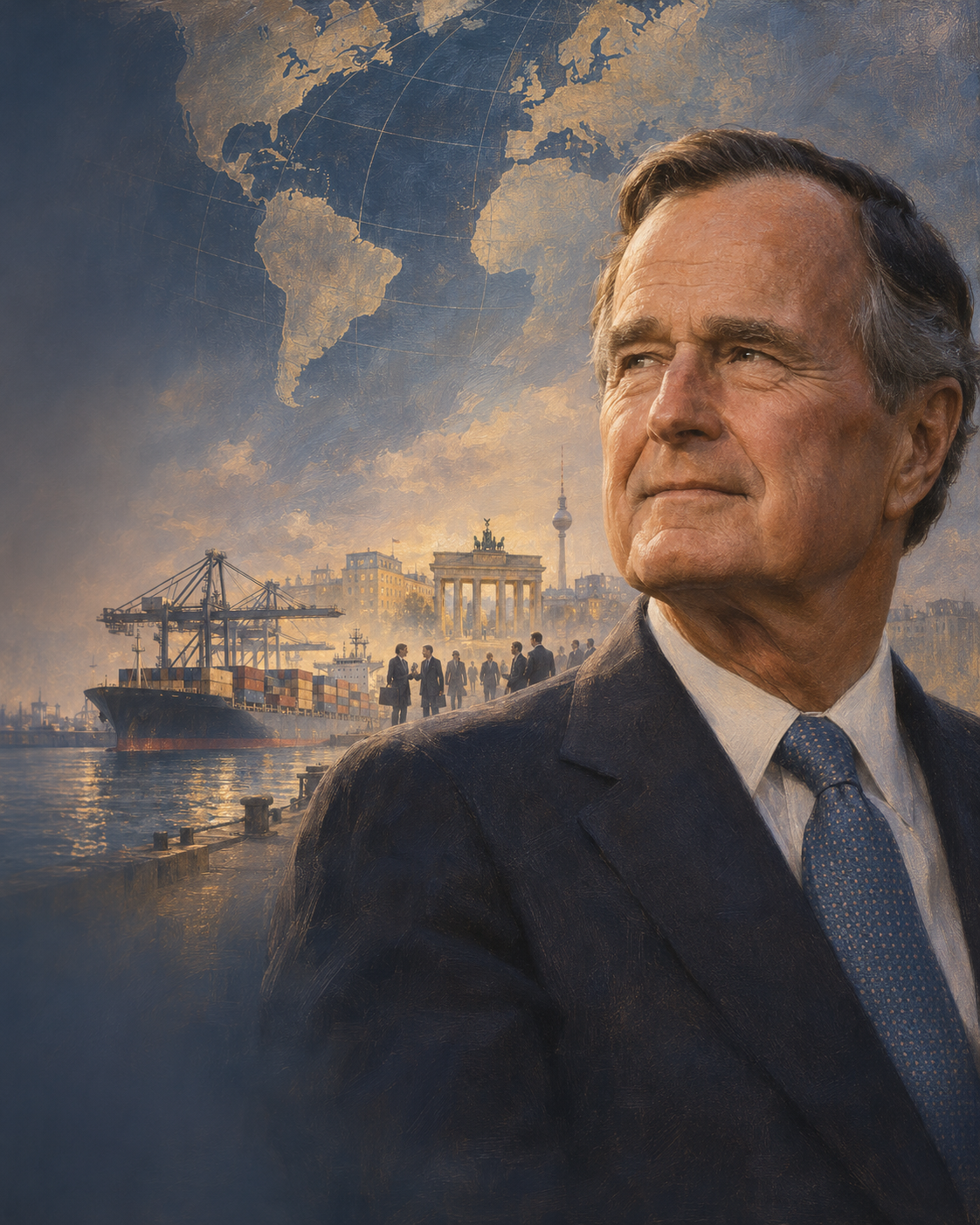
JANUARY 20, 1989 — JANUARY 20, 1993
What does a president do when the map changes?
George H. W. Bush inherited an assertive trade law, a pending Soviet opening and an emerging North American agreement. He then faced Tiananmen, revolutions in Europe, the Gulf War and the Soviet Union's collapse. Commercial diplomacy became a way to shape an uncertain peace—but his version drew lines around rights, security and access that deserve examination.
The man who had served as Reagan's vice president was neither a simple continuation nor a complete break. Reagan's 1988 trade law supplied enforcement powers, and the Canada agreement was already in force when Bush took office. Reagan had opened commercial talks with Gorbachev; Bush first reviewed Soviet policy, then negotiated a treaty and later pivoted to the independent states. He pursued export promotion, North American rules and hemispheric debt relief with an experienced diplomat's preference for coalitions, while still making hard unilateral choices in China, Panama and Iraq.
In December 1991, preparing for an Asia-Pacific business trip, Bush said The sharp lines that once separated foreign and domestic policy have been overtaken by a new reality.
It was a statement of purpose, not proof that every new relationship delivered jobs or democratic rights. This profile follows what was proposed, what was signed, what actually took effect, and whose choices determined the result.
THE INSTITUTIONAL CHOICE
A trade strategy becomes a working system.
Bush used the first 1989 “Super 301” identification authorized by Reagan's 1988 law to seek talks over barriers in Japan, India and Brazil. He said Our goal is to open markets and to eliminate trade barriers.
The U.S.–Japan Structural Impediments Initiative simultaneously examined practices in both economies. Identifying barriers and beginning cases did not mean every demand was won; he still called the multilateral Uruguay Round central to the strategy.
The Export Enhancement Act of October 1992 renewed Export–Import Bank authorities and put the Trade Promotion Coordinating Committee on statutory footing after Bush had established an interagency version in 1990. It addressed export finance and encouraged Commerce commercial-service offices to act as one-stop shops. The Jobs Through Exports Act made the existing Trade and Development Program an independent agency and authorized U.S. Commercial Centers abroad. The laws built tools and authority; they do not prove every center opened or every exporter made a sale. The first governmentwide Toward a National Export Strategy report arrived in 1993 under Clinton.
Asia-Pacific Economic Cooperation began with twelve founding economies in 1989, after Australian Prime Minister Bob Hawke proposed a forum. Bush's administration joined it and encouraged stronger ties; the first leaders' meeting took place later, under Clinton. Similarly, Reagan's Uruguay Round ran through Bush's term and past a failed 1990 deadline. A 1992 U.S.–European Community agricultural understanding cleared a large obstacle, but the Round concluded in 1993 and the WTO agreements were signed in 1994. Bush's role was significant without claiming his successor's finish.
FOUR REGIONAL READINGS
Four regions.
A changing map of choices.
Each chapter weighs Bush's own actions against inherited arrangements, the decisions of partners and the experience of people affected by trade, sanctions and war. Country links lead to present-day Commercial Diplomacy Index research, not 1989–1993 scores.
Markets after empire.
Whose timetable?
Bush's Africa policy crossed apartheid's dismantling, Namibia's independence, Angolan negotiations and humanitarian emergencies. African leaders did not wait for Washington to define their needs.
South Africa: a contested moment to lift sanctions
Reagan's veto had been overridden when Congress enacted the 1986 anti-apartheid sanctions. Under Bush, South Africans pushed change: F. W. de Klerk unbanned liberation organizations and released Nelson Mandela in February 1990; decades of organizing and external pressure preceded the opening. Bush terminated most federal economic sanctions in July 1991 after his administration determined that the 1986 law's conditions were met. He argued renewed trade and investment could help build a different economy, while acknowledging Much remains to be done
. The arms embargo and restrictions on U.S. support at the IMF remained. Democratic elections and Mandela's presidency came in 1994, after Bush left office.
Mandela's July 1991 address said sanctions should continue. In a declassified call with Bush, he credited U.S. sanctions and told him On lifting the sanctions, we differ on timing
and your action is premature
, citing remaining prisoners, unequal public services and violence. He thanked Bush for consultation; Bush promised continuing diplomatic pressure and assistance for black South Africans. The question is not whether investment mattered; it is whether lifting leverage before full political equality served the people who had borne apartheid's cost.
Namibia and Angola: an inherited accord, unfinished peace
Reagan's diplomacy helped produce the December 1988 Angola–Namibia accords. Bush recognized Namibia's March 1990 independence and designated it for preferential U.S. market access in 1991. In a declassified conversation, President Sam Nujoma pressed concrete needs: water, health, education, debt and Namibian control of fishing resources. Bush described higher assistance and emphasized private investment; Namibian ministers discussed joint ventures and a planned business conference. This was a negotiation over the kind of development Namibia wanted, not simply a U.S. market-opening ceremony.
Bush continued support for UNITA as Angolans negotiated the 1991 Bicesse accords. He authorized prospective election aid and, at the parties' and UN's request, deployed aircraft for the 1992 process. Authorization was not proof that the settlement held. The UN record describes renewed fighting after UNITA challenged the election outcome. The earlier security preference and the later peace effort must both be kept in view.
His political alliances require similar scrutiny. Bush welcomed Mobutu Sese Seko of Zaire, now the Democratic Republic of the Congo, in 1989 as a valued friend and discussed Angola, while his administration also raised human rights and economic reform. State's later account describes repression and corruption under Mobutu. Diplomatic usefulness did not erase those harms. The encounter says more about Washington's security preferences than it does about a broad benefit for the Congolese public.
Relief, debt and African-led action
Bush announced forgiveness of certain official development loans to sub-Saharan countries in 1989, building on a multilateral debt-relief pledge. That policy was not a per-country ledger of delivered relief. In Liberia, he supported ECOWAS-led peacekeeping and refugee assistance; the regional coalition led its own intervention. In Somalia, after a UN Security Council mandate, Bush ordered Operation Restore Hope in December 1992 to protect food delivery. His humanitarian aim was real, but relief access was not a completed political settlement when his term ended.
Assessment: Bush connected debt, private investment and aid to African transitions. His early end to most South Africa sanctions was directly contested by Mandela, and Angola's peace collapsed. Namibia's Nujoma and African regional institutions made their own priorities impossible to reduce to a White House trade slogan.
Engagement, enforcement.
And the cost of security.
Bush carried long-standing Asian alliances into a new trade push. Tiananmen and the Gulf War exposed the limits of his belief that economic contact and strategic cooperation could coexist with rights concerns.
China and Taiwan: condemning violence, keeping commerce
Relations with Beijing were inherited from Carter's normalization and Reagan's subsequent management of Taiwan ties. After China's army crushed protests in June 1989, Bush condemned the killings, suspended government-to-government arms sales and military exchanges, and promised sympathetic consideration to Chinese students in the United States. He then restricted official visits and sought a pause in new international-finance loans. These were targeted acts, not a complete U.S. trade embargo.
At the same time, he quietly sent senior emissaries to Beijing and argued that broad commercial contact could preserve influence. He vetoed Congress's 1992 attempt to condition China's most-favored-nation status on human-rights benchmarks. Engagement was a theory of future change, not proof that the people demanding reform had gained protection. Bush's 1990 order deferred forced departure for many Chinese nationals in the U.S. Separately, his 1992 decision to sell F-16s to Taiwan marked another strategic choice and was framed in part around American jobs; authorization did not mean all aircraft were delivered within his presidency.
Japan, Korea, India and the Pacific forum
Bush and Japanese Prime Minister Sōsuke Uno launched the Structural Impediments Initiative in 1989 to address barriers and savings/investment patterns in both countries. He pressed for access in semiconductors, satellites, government procurement and retail. In 1992 he visited a Toys “R” Us opening in Japan as a tangible example of retail reform while acknowledging work remained. One store was evidence of a changed rule, not proof that the entire trade imbalance was solved.
In South Korea, President Roh Tae-woo pursued his own Northern Policy and defended politically sensitive agricultural interests even as Bush asked for wider market access. Their 1992 agreements addressed science, technology and patent secrecy, not every outstanding trade dispute. In India, as Indian leaders undertook their own 1991 economic reforms, Bush suspended duty-free treatment for specified goods over intellectual-property protection in 1992—a narrower move than an embargo. The U.S. joined APEC's original ministerial forum; Australian, ASEAN and other governments shaped it. The Philippine Senate's rejection of a new Subic base agreement showed that even a security partner could say no.
Kuwait, Iraq and the boundary between oil security and human security
Bush's October 1989 national-security directive sought a working commercial and political relationship with Saddam Hussein's Iraq while acknowledging weapons and human-rights concerns. After Iraq invaded Kuwait in August 1990, Bush froze Iraqi assets and prohibited U.S. transactions; the UN later authorized force if Iraq did not withdraw. Kuwait's government, Saudi Arabia, Egypt, Turkey, Britain and other partners made decisions of their own in a broad coalition. The 1991 operation expelled Iraq from Kuwait and restored its sovereignty. Security of Persian Gulf oil supplies was a major concern, but protecting oil was not the only publicly stated purpose.
The victory did not settle Iraq's future. A 1991 UN field mission reported severe failures of water, electricity and civilian infrastructure after war, sanctions and disruption. Bush ordered relief as Kurdish and other refugees fled. To call this simply a successful restoration of commerce would leave civilians outside the frame. The U.S. and Soviet Union later co-sponsored the Madrid peace conference hosted by Spain; talks began, but a final regional peace did not arrive in his term.
Assessment: Bush used trade enforcement with Japan and India, protected Chinese students while preserving Beijing commerce, and built an effective coalition to free Kuwait. Rights advocates in China, the Philippine Senate and Iraqi civilians reveal where his strategic hierarchy produced limits or costs.
Revolutions from below.
Rules negotiated above.
Bush helped frame a new relationship with Europe, but Polish organizers, East German crowds, Gorbachev, Kohl and new post-Soviet governments moved the map.
Poland and Germany: supporting a transition they led
Bush's early 1989 review of Soviet policy was a pause from Reagan's late-term momentum. The Berlin Wall fell in November as East German citizens crossed and challenged a failing regime. Bush supported a unified Germany within NATO through the 1990 Two Plus Four settlement involving the two German states, the U.S., Britain, France and the Soviet Union. His unity remarks credited German citizens and Chancellor Helmut Kohl. He contributed to the security conditions of reunification; he did not bring down the Wall by himself.
Poland's Solidarity movement and Hungarian reformers made their own breakthroughs. In a July 1989 address in Warsaw, Bush proposed an enterprise fund, investment support and coordination with G7 partners; the SEED Act later authorized aid to Poland and Hungary. He signed a U.S.–Poland business treaty in 1990. The new market system was a political and social undertaking, not a transaction completed at signing. A 1992 GAO review found U.S. aid planning to Poland and Hungary needed better country-specific strategy.
Two different Moscow trade stories
Reagan and Gorbachev had convened a joint Soviet commercial commission in 1988. Bush and Gorbachev went farther, signing a bilateral trade agreement in June 1990. But it did not enter into force for the USSR before that country ceased to exist. Bush's 1990 Jackson–Vanik waiver could enable certain credits; most-favored-nation treatment still depended on later steps. Calling the unimplemented pact a completed Soviet free-trade opening would mistake signature for effect.
On June 17, 1992, Bush and Boris Yeltsin announced Russia's most-favored-nation status and new investment and trade arrangements, a distinct successor-state relationship. The FREEDOM Support Act that October authorized assistance and exchanges for Russia, Ukraine and other newly independent states. It did not certify that democracy, private enterprise or every financed project would succeed. Former Soviet peoples and governments had competing aspirations and severe economic dislocation.
Allied cooperation and an unfinished global round
Bush welcomed European integration, and the 1990 Transatlantic Declaration made U.S.–European Community consultation regular. Agriculture nonetheless divided negotiators in the Uruguay Round. The 1992 Munich G7 declaration acknowledged slow progress. The November 1992 U.S.–EC Blair House agricultural understanding helped negotiations, but the Round was completed and signed after Bush's presidency. European leaders were counterparts, not a single market to be ordered open from Washington.
Assessment: Bush helped stabilize German unity, backed Polish and Hungarian enterprise and established a real Russia trade channel. The Soviet treaty's failure to take effect, GAO's aid critique and unfinished Uruguay Round show why diplomatic agreement, enacted authority and durable economic change must be counted separately.
A hemispheric promise.
Uneven sovereignty.
North American rules and debt measures were a major commercial legacy. The uses of force and embargoes in Panama, Haiti, Cuba and Nicaragua belong in the same account.
North America: a negotiated agreement, a later start
The Canada free-trade agreement entered into force January 1, 1989, after Reagan and Mulroney negotiated it. Mexico's President Carlos Salinas de Gortari proposed bilateral talks in 1990; Canada sought a seat, and all three leaders agreed to a trilateral negotiation. This was not a unilateral U.S. offer. The proposed rules extended to investment, services, intellectual property and dispute processes, making workers, small firms and border communities potential participants in a much larger restructuring.
Bush, Salinas and Mulroney attended the October 1992 initialing in San Antonio and signed NAFTA in December. The San Antonio scene makes the diplomacy tangible, but a signature was not implementation. Congress approved, and Clinton signed the implementing act in 1993; NAFTA took effect January 1, 1994. The agreement's later gains and losses require evidence beyond the White House's 1992 projections.
Trade, investment and debt beyond North America
Treasury Secretary Nicholas Brady, appointed under Reagan and retained by Bush, advanced a 1989 strategy for commercial-bank debt reduction as Mexico and other borrowers negotiated with creditors. This bank-debt channel was distinct from Bush's later official-debt initiative. Bush's 1990 Enterprise for the Americas Initiative proposed trade frameworks, an investment fund and conditional official debt reduction, including debt-for-nature possibilities. His formulation was prosperity in our hemisphere depends on trade, not aid
. Elected Latin American governments had their own reform strategies, and the program required congressional and multilateral participation. The ultimate hemispheric free-trade area remained a goal, not a completed Bush-era agreement.
There were intermediate steps: Congress created an EAI facility and later enacted further authorities; a 1991 White House accounting listed trade and investment frameworks with a number of governments. Argentina, Brazil, Paraguay and Uruguay proposed a regional council. These frameworks opened dialogue but were not FTAs. A 1991 arrangement reduced Chile's food-assistance debt, while Treasury records EAI debt relief for Bolivia and Jamaica that year and Colombia and El Salvador in 1992. Bush expanded inherited Caribbean Basin preferences; conditions and exclusions still shaped who benefited. Chile's return to trade-preference eligibility followed worker-rights review after its democratic transition.
Panama, Nicaragua, Haiti and Cuba: power alongside access
In December 1989 Bush ordered the invasion of Panama, citing Americans' safety, Manuel Noriega, democracy and canal treaty obligations. His administration restored access to blocked Panamanian assets under Guillermo Endara. Yet the UN General Assembly condemned the invasion as a violation of sovereignty; civilians died and property was damaged. In 2018, the Inter-American Commission found U.S. responsibility for violations of civilians' rights to life, security and property; the U.S. contested the Commission's legal interpretation. The Canal and financial channels cannot be narrated without Panamanians.
After Nicaraguans elected Violeta Chamorro in 1990, Bush lifted the Reagan-era trade embargo and proposed reconstruction aid. A proposal was not proof of disbursement, and Nicaragua's voters made the political choice. The Salvadoran government and FMLN signed their 1992 peace accord; Bush made funds available for peacekeeping. After Haiti's 1991 coup, Bush imposed economic restrictions in response to a regional call for action. The high-seas interdiction system predated him, but his May 1992 order authorized direct return of Haitians without an asylum-screening requirement, a policy UNHCR criticized. Aristide was not restored until 1994. The 1992 Cuban Democracy Act tightened Cuba trade restrictions, while preserving some humanitarian and telecommunications exceptions. Regional engagement was selective.
Assessment: Bush negotiated the agreement that became NAFTA and gave the hemisphere a more specific trade-investment-debt architecture. Salinas, Mulroney and Latin American governments were coauthors, not accessories. Panama, Haiti and Cuba show that his policy did not apply one definition of openness to every neighbor.
THE YEARS IN OFFICE
A timeline of openings, limits and handoffs.
- Trade law meets a changing world.
Canada's Reagan-era agreement is already in force when Bush takes office. Bush activates Super 301; Chinese forces crush protests and he responds with targeted sanctions while keeping commercial ties. Poland and Hungary reform; the Berlin Wall falls; APEC's ministers first meet.
- New states and a hemispheric proposal.
Namibia becomes independent. Bush signs the Soviet trade agreement, supports German unity and announces the Enterprise for the Americas Initiative. Iraq invades Kuwait; sanctions and a coalition follow. Salinas proposes FTA talks.
- War, apartheid and new negotiations.
Kuwait is liberated, Bush ends most South Africa economic sanctions over Mandela's timing objection, and NAFTA talks proceed. The Soviet Union dissolves in December. The Uruguay Round remains unfinished.
- Rules signed; outcomes still ahead.
Russia gains MFN status. Congress enacts export-promotion and trade-development laws. NAFTA is initialed in San Antonio in October. Bush orders a UN-authorized humanitarian deployment to Somalia in early December; he signs NAFTA on December 17. The agreement is implemented after he leaves office January 20, 1993.
THE EDITORIAL ASSESSMENT
He built frameworks.
Others determined their fate.
Bush's commercial diplomacy had substance: trade enforcement, export-promotion institutions, Poland/Hungary enterprise support, a Russia trade relationship, hemispheric debt-and-investment machinery and a signed North American agreement. His coalition work helped Germany reunify and Kuwait regain sovereignty. The diplomacy of James Baker, Carla Hills and Robert Mosbacher mattered; so did the agency of Kohl, Gorbachev, Yeltsin, Salinas, Mulroney, Mandela, Nujoma, Hawke and ordinary citizens.
The exclusions are equally revealing. Bush chose commercial engagement with China after Tiananmen over stronger trade conditions; lifted most anti-apartheid sanctions earlier than Mandela wanted; used force in Panama under international criticism; and left severe Iraqi civilian needs after the war. His rhetoric about trade was an organizing idea, not a uniform rule. Some agreements were signed but not effective, some authorities were enacted but not yet implemented, and some transitions were made by people outside the White House. That is the measure of a presidency in a changing world.
Evidence and editorial method
The linked record uses Bush's public papers and library files, enacted U.S. law, contemporaneous GAO reports, USTR, APEC, UN and regional human-rights records, and statements from African leaders. Presidential claims are compared with independent or counterpart accounts where possible. A proposal, authorization, signature, effective rule, military outcome and later political settlement are deliberately different categories. The Office of the Historian's 1989–1992 period is retired and no longer maintained; direct contemporary records carry the factual claims here.
The linked Commercial Diplomacy Index country profiles offer present-day geographic context, not historical scores or proof of cause and effect. Modern states are not interchangeable with the former Soviet Union. This article's original illustration does not imply that a particular meeting was photographed.