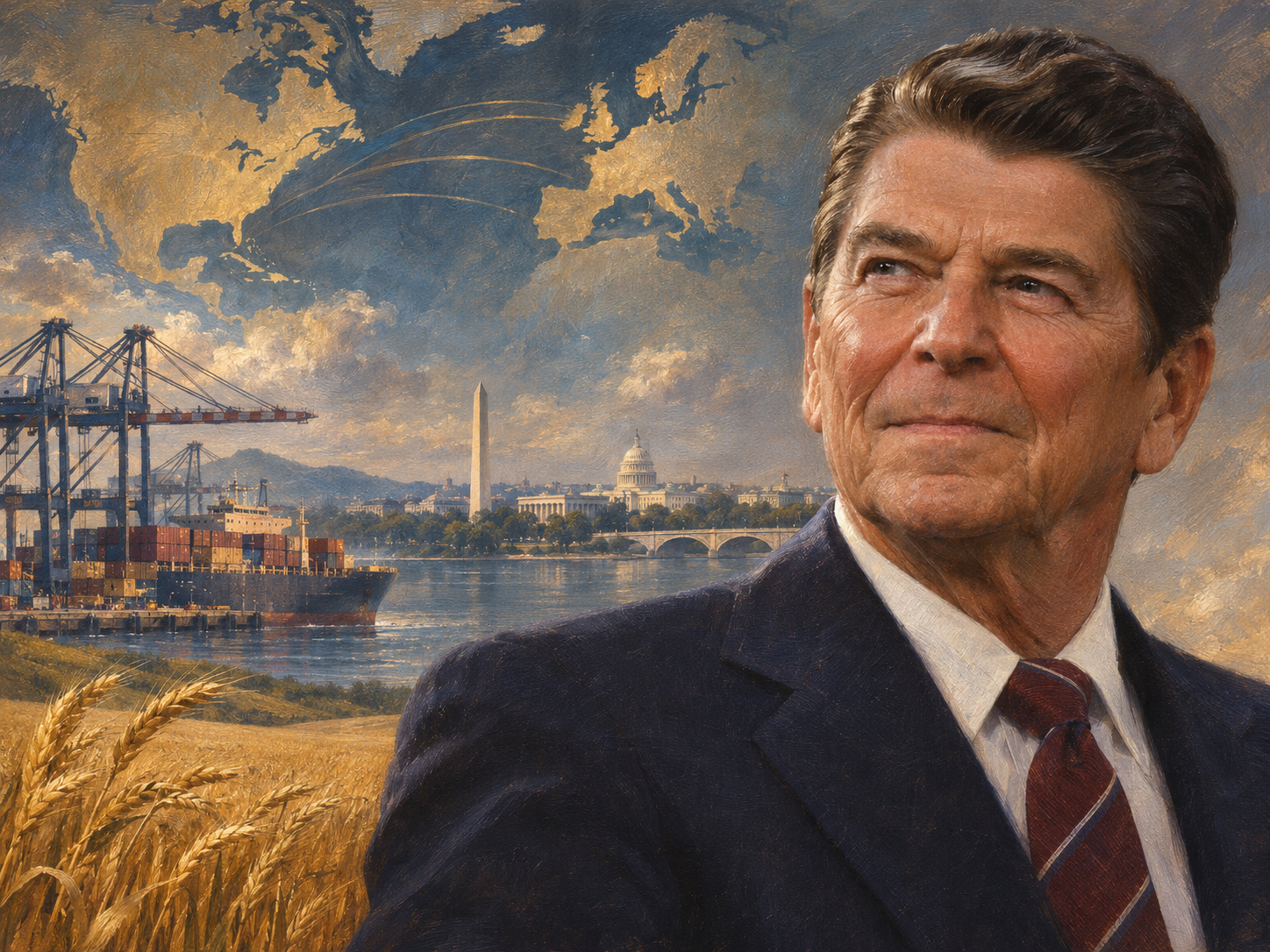
JANUARY 20, 1981 — JANUARY 20, 1989
Which doors should America open—and which would it close?
Ronald Reagan spoke the language of open markets. He also used tariffs, sanctions, technology controls and security relationships to decide whose access counted. His two terms cannot be captured by either slogan alone.
He inherited the Carter administration’s commercial officers at Commerce, the Tokyo Round rules, normalized relations with China, and an unfinished argument over trade with the Soviet Union. The China opening itself reached back through Ford to Nixon. Reagan changed the balance: he lifted Carter’s Soviet grain restriction, pressed allied markets more aggressively, championed a Canadian trade agreement, and built new U.S. trade-enforcement law. He also challenged Carter’s Panama settlement in campaign rhetoric, then administered the treaties once president.
The first term was marked by anti-Soviet pressure, open-market advocacy and considerable tolerance for authoritarian security partners. The second brought sharper trade enforcement, popular democratic transitions in several allied countries, bargaining with Mikhail Gorbachev, and the Iran–Contra scandal. The people on the other side—Japanese negotiators, Canadian leaders, South African opponents of apartheid, Filipino citizens, Central Americans, farmers and exporters—were not mere scenery in a presidential story. Their choices, objections and costs are part of this account.
THE INSTITUTIONAL CHOICE
Free trade as a goal. Fair trade as a test.
Reagan did not create the overseas U.S. commercial service. Carter’s reorganization moved the function from State to Commerce in 1980; it became the U.S. and Foreign Commercial Service in 1981. The Commerce history traces that continuity. Reagan’s early budget instincts were not simply to increase export support: in a February 1981 recovery address, he proposed cutting Export–Import Bank loan authority by one-third and called it a business subsidy. The bank continued operating; its later history describes 1987 program changes aimed at smaller exporters. A proposal to cut authority and a later program adjustment should not be mistaken for a single uninterrupted export-financing expansion.
By September 1985, Reagan described a Trade Policy Action Plan. He said, we want to sell more of our goods to other nations
. The administration announced trade cases involving Japanese tobacco, Korean insurance and Brazilian technology barriers, proposed financing and sought a new multilateral round. An announced case and a proposed fund were not themselves a sale or an enacted appropriation. His July 1986 formulation was plainer: trade must also be fair
. The claim invited a practical question: whose barriers could Washington persuade a partner to lower, and who absorbed the costs of retaliation?
Allied finance ministers and central banks—not Reagan alone—coordinated the 1985 Plaza and 1987 Louvre currency arrangements. Currency shifts were meant to address external imbalances but were not a trade agreement or a guarantee that a particular factory would sell abroad. In 1986 the Uruguay Round began work on agriculture, services, investment and intellectual property. It was not concluded during his term; the later WTO settlement belongs to a subsequent era.
Reagan signed the Omnibus Trade and Competitiveness Act on August 23, 1988, after vetoing a different trade bill earlier that year. The enacted statute strengthened the U.S. Trade Representative, broadened enforcement and established priority-country and intellectual-property procedures. The “Super 301” identification rounds were scheduled for 1989 and 1990: Reagan signed the authority, while its first operational use came after he left office. This was a durable change in bargaining power, not evidence that every foreign barrier disappeared.
FOUR REGIONAL READINGS
Four regions.
Different definitions of openness.
Each chapter distinguishes an inherited opening from Reagan’s own choice, a signed rule from its later effect, and a presidential claim from what partners and affected people experienced. Country links lead to present-day research in the Commercial Diplomacy Index; they do not measure the 1980s.
Market access.
Apartheid’s moral boundary.
Reagan pursued commercial relationships, development finance and famine relief. His opposition to stronger apartheid sanctions exposed how far he was willing to let economic pressure go.
Economic ties, institutions and relief
The administration continued a U.S.–Nigeria dialogue begun before Reagan. A 1981 delegation led by Vice President George H. W. Bush joined the sixth round of bilateral economic talks on agriculture, energy, investment, health and technology. Commerce announced a four-country trade and investment mission to Cameroon, Côte d’Ivoire, Nigeria and Morocco. Missions created opportunities for meetings; the announcements do not certify completed transactions. African governments had their own negotiating priorities, not just U.S. export targets.
U.S. membership in the African Development Bank in 1983 was a concrete institutional step, though U.S. technical and fund relationships preceded Reagan. During the 1984–85 famine, he reported committed emergency food aid and directed a larger initiative; commitments, proposed packages and delivered food are different stages. Trade diplomacy does not stand apart from whether people can eat. In 1987 Reagan and Kenya’s Daniel arap Moi discussed investment, and Moi used the same appearance to press for action against apartheid. A meeting goal did not demonstrate realized investment, and an African president spoke for his own agenda.
South Africa: sanctions became law over his veto
Reagan denounced apartheid and issued targeted restrictions in 1985, while his “constructive engagement” approach favored continued contact and negotiation over wider economic isolation. The divide became unmistakable in 1986. He vetoed the Comprehensive Anti-Apartheid Act; Congress overrode the veto and made the broader sanctions law. His own statement on the override expressed regret, and his administration then implemented the statute. It would erase Congress’s choice to credit Reagan with voluntarily enacting the whole package.
The test of this approach was not merely whether a president condemned racial oppression. In a 1987 report, Reagan acknowledged that there has not been significant progress toward ending apartheid since October, 1986
. The people organizing against apartheid, neighboring African governments and members of Congress were consequential actors. Apartheid did not end in his presidency. A commercial relationship that preserves access for firms while excluding people from equal political rights cannot be evaluated by investment opportunities alone.
Angola and Namibia: a settlement with unfinished consequences
Reagan supported Jonas Savimbi’s UNITA in the Angolan civil war while his administration sought a settlement linking Cuban troop withdrawal from Angola to Namibian independence from South African rule. A 1986 national-security directive explicitly connected political, commercial and strategic interests. Reagan reaffirmed support for Savimbi in 1988; that support should not be collapsed into support for all Angolans or into a peaceful business opening.
Angola, Cuba and South Africa signed the December 1988 regional accords after negotiations involving U.S. diplomacy and African and Cuban decision-makers. Reagan welcomed the pathway to Namibia’s independence, but independence itself came in 1990, after he left office. The signed accord was substantial; the conflict’s human costs and the later implementation date remain part of the record.
Assessment: Reagan built actual economic channels and joined an African development institution, while African leaders pressed their own development and political demands. His apartheid veto and continued security choices in southern Africa reveal a clear hierarchy: he would use some pressure, but resisted stronger commercial isolation until Congress required it.
Trade with allies.
Security with a price.
Reagan expanded commercial contact with China, pressed Japan for market access, and maintained alliances that were tested by democratization, occupation and covert dealing.
China and Taiwan: sustaining two distinct relationships
Carter had normalized relations with Beijing. Reagan neither began that opening nor simply reversed it. The August 1982 communiqué and Reagan’s accompanying statement addressed China’s objection to American arms sales to Taiwan while he maintained commitments under the Taiwan Relations Act and spoke of continuing unofficial commercial and cultural ties. Washington’s position depended on expectations about peaceful handling of the dispute. Beijing and Taipei did not have interchangeable interests, and an arms-sales statement was not a settlement of sovereignty.
During his 1984 China visit, Reagan and Premier Zhao Ziyang signed tax, cultural and management arrangements and initialed a nuclear-cooperation text. Initialing that text was not a completed reactor sale. The meetings made the inherited diplomatic opening more operational for people, companies and universities; they also left the strategic contest over Taiwan unresolved.
Japan, Korea and the Philippines: partners bargaining back
Japan was an ally and a formidable competitor, not an adversary Washington could command. Prime Minister Yasuhiro Nakasone’s 1985 import action program was a Japanese policy response; the White House reserved judgment about measurable access. A semiconductor agreement sought to curb dumping and open Japan’s market. When Reagan found noncompliance, he ordered tariffs on selected imports in 1987, later relaxing part of the sanction as he assessed compliance. This was negotiated trade plus selective retaliation, not a pure hands-off marketplace.
Reagan’s 1981 communiqué with South Korea’s Chun Doo-hwan emphasized security, trade and U.S. troops. When Koreans won a path to direct elections in 1987, Reagan welcomed the change. Credit for mobilization belongs principally to Korean citizens, not to a presidential visit. In the Philippines, the inherited bases relationship helped keep Ferdinand Marcos strategically useful despite repression. Reagan’s 1986 response to election fraud came amid Filipino resistance; after People Power, Washington recognized Corazon Aquino’s government. The transition was Filipino-led. Reagan later discussed economic help and investment, but pledges did not themselves repair every business or democratic institution.
Indonesia: the unresolved rights test
In an 1986 address in Indonesia, Reagan praised growth and ASEAN enterprise under Suharto. U.S. State correspondence also acknowledged East Timor human-rights concerns. Reagan did not resolve the occupation or the denial of Timorese self-determination. This is where an account framed only around regional growth or a friendly government would leave out the people whose rights bore the cost.
The Gulf and Iran: oil-route security, secrecy and civilians
Saudi Arabia was a security and energy partner, not just a buyer of U.S. goods. Reagan sought approval for AWACS and related defense sales in 1981; the Senate approved the package. Amid the Iran–Iraq war, he defended protecting Gulf navigation and Kuwait tanker escorts in 1987. The policy treated an oil route as a global economic artery while drawing U.S. forces into a dangerous war zone. In July 1988 the USS Vincennes shot down Iran Air Flight 655; Reagan called the civilian deaths a tragedy and argued that the ship had acted defensively. The killed passengers cannot be omitted from the price of that security strategy.
Iran–Contra revealed another boundary. Reagan initially denied trading arms for hostages. In March 1987, he acknowledged that the facts and the evidence tell me it is not
true of his earlier description and accepted responsibility for the operation. The investigative record documents the diversion of proceeds to Nicaragua’s Contras. It does not require claiming that Reagan personally ordered that diversion. Secret arms transfers outside ordinary public accountability are the opposite of the transparent, rule-bound exchange his trade rhetoric promised.
South Asia: partnership under a nuclear shadow
Reagan and India’s Rajiv Gandhi discussed science, technology and private trade as well as export-security differences. In Pakistan, he worked with Zia-ul-Haq and then Prime Minister Junejo on Afghanistan and economic cooperation, despite concern over Pakistan’s nuclear program. The 1988 Geneva timetable set a Soviet withdrawal for February 1989, after Reagan left office. Afghan resistance and refugees were actors with interests of their own; neither a U.S. aid pledge nor a timetable was the end of Afghanistan’s conflict.
Assessment: Reagan made inherited China ties more useful, bargained hard with Japan, and ultimately supported democratic transitions in Korea and the Philippines. His earlier tolerance of authoritarian partners, unresolved East Timor policy, civilian deaths in the Gulf and Iran–Contra undercut any simple portrait of open, accountable diplomacy.
Allied markets.
Different red lines.
Reagan’s European partners shared a security alliance, but they disputed U.S. trade restrictions, agricultural policy and the costs of confronting Moscow. By the second term, even Soviet commercial contact was back on the table.
The pipeline dispute: allies did not take orders
Reagan ended Carter’s Soviet grain restriction in April 1981, arguing that farmers had borne an unfair burden. After repression in Poland, his administration restricted oil-and-gas technology for a Soviet pipeline, including measures affecting European firms and subsidiaries. Britain, France and West Germany objected to the extraterritorial reach and to the fact that American grain exports continued. The State Department’s institutional history records the disagreement. In a November 1982 address, Reagan lifted the pipeline sanctions after negotiating tighter allied controls on strategically sensitive trade. He changed course under allied pressure while retaining a security distinction between wheat and industrial technology.
The 1983 Williamsburg declaration was a joint statement by leaders with their own economic and political mandates: resist protectionism, consult on currencies, broaden GATT work and weigh East–West commerce against security. Agreements among allies created a framework, not a unilateral American command or proof that every announced goal was met. Within the European Community, farm subsidies and industrial barriers still prompted friction. Reagan described threatened retaliation over canned-fruit subsidies in 1986 even as he sought a negotiated path.
Negotiating new rules and currencies
Reagan and European leaders pushed the 1986 Uruguay Round to take up agriculture, services and intellectual property; his 1988 appeal called for opening markets. The Toronto summit declaration shows that agriculture remained disputed. His term launched negotiations rather than delivering the later WTO settlement. The joint Plaza and Louvre currency arrangements likewise required German, French, British and Japanese decisions alongside the United States; the Treasury account distinguishes coordinated exchange-rate adjustment in 1985 from an attempt at stability in 1987. None of these agreements guaranteed a particular company an order or a worker a job.
Poland and the transition from confrontation to contact
Reagan imposed economic sanctions on Poland after martial law and defended independent unions. In 1987 he restored most-favored-nation treatment and access to official credits, crediting appeals from Solidarity and the Polish Church while acknowledging that free unions remained constrained. The people who organized in Poland were more than beneficiaries of a U.S. tariff decision.
NATO’s dual-track response to intermediate-range missiles began in 1979, before Reagan; he took that inherited allied framework into negotiations with Soviet leader Mikhail Gorbachev. Their December 1987 summit statement recorded the INF arms treaty and, separately, plans for a Joint Commercial Commission and possible lawful joint ventures. The 1988 Moscow statement reported trade working groups and resumed air-service discussions while recognizing serious disagreements. An arms-control success helped create space for contact; it was not a free-trade pact or the end of the Cold War on Reagan’s last day.
At the Brandenburg Gate, Reagan called for the Berlin Wall to fall and for more convenient commercial air access to the city. The human and economic meanings of access were linked, but the Wall fell in 1989, after his presidency. German and other European agency, including Chancellor Helmut Kohl’s role in allied security decisions, belongs in the account.
Assessment: Reagan defended farmers’ Soviet sales while restricting strategic technology, then adjusted his pipeline policy after European resistance. His later dialogue with Gorbachev marked a real shift in his presidency, but trade commissions were still exploratory. Allied negotiation, Polish civic action and Soviet choices shaped what U.S. leadership could accomplish.
New preferences.
Old questions of sovereignty.
Reagan created a Caribbean trade instrument and negotiated with Canada and Mexico. Central American wars and Panama show that commercial access was also a tool of geopolitical pressure.
The Caribbean Basin: opportunity with exclusions
Reagan’s 1982 proposal to the Organization of American States combined tariff preferences, aid, investment and security. He acknowledged that roughly 87 percent of existing Caribbean exports already entered the U.S. duty-free, so the new preferences were meant to invite diversification and future production as much as reward existing flows. Congress enacted the Caribbean Basin Economic Recovery Act in 1983, and the preferences began January 1, 1984 for designated beneficiaries. Countries had to qualify, and the program excluded major categories.
A contemporaneous GAO review found petroleum, most textiles and certain leather products outside the preferences; it reported that early regional exports fell amid commodity-price and demand changes while some nontraditional goods grew. That is neither proof that the program failed everywhere nor proof that tariff access alone transformed the region. Investors, workers and Caribbean governments faced distinct opportunities and restrictions. Carter’s earlier Caribbean Group had emphasized multilateral development coordination; Reagan’s new instrument made preferential market access and a security filter more prominent.
Canada and Mexico: negotiated terms, not gifts
Canadian Prime Minister Brian Mulroney proposed broad bilateral negotiations in 1985. After difficult bargaining, the governments signed the U.S.–Canada Free Trade Agreement in January 1988. Reagan signed implementing legislation in September; Canada completed parliamentary approval in December; the agreement entered into force January 1, 1989, shortly before Reagan left office. It established rules and dispute processes for deeply connected economies. It was not NAFTA, which entered into force later.
Mexico’s President Miguel de la Madrid pursued his own reforms and joined GATT in 1986 during a debt and oil-price crisis. Reagan offered support for international financing and market access and discussed bilateral trade frameworks. Their public exchange shows that Mexico wanted an economic strategy it could defend, including non-oil exports and terms of reciprocity. Credit and investment proposals were not a cure for the debt crisis. This partnership helped set the stage for later North American negotiations without making Reagan the author of a 1994 agreement.
Central America: trade preference and economic blockade
The contrast between preference and coercion was stark. Reagan supported elected Salvadoran President José Napoleón Duarte and welcomed his 1984 election, while also supplying military and economic aid in a civil war. The Inter-American Commission on Human Rights welcomed the civilian political opening yet found continuing death-squad and military abuses and inadequate investigations. A democratic election mattered; it did not erase the suffering of civilians or settle accountability.
Reagan imposed a near-total trade embargo on Nicaragua in 1985 while supporting forces fighting the Sandinista government. The International Court of Justice’s 1986 judgment held that U.S. military and paramilitary activities violated nonintervention and other international obligations and examined interference with peaceful maritime commerce; Washington did not accept the Court’s judgment. One can question Sandinista repression and still examine the legality and human cost of U.S. methods. The secret Iran–Contra diversion added a profound accountability failure to this policy.
Reagan praised Guatemala’s Efraín Ríos Montt in 1982, while the Inter-American Commission’s investigation documented grave abuses against rural civilians under his rule and also addressed insurgent violence. This is a severe test of whom U.S. anti-communist support legitimized. Costa Rican President Óscar Arias and regional leaders, meanwhile, fashioned a 1987 Central American peace accord. Reagan’s response was cautious. The peace plan was theirs, not a U.S. initiative to claim after the fact.
Panama, Grenada and South America: sovereignty under stress
Reagan’s 1976 campaign line about the Panama Canal was emphatic: We bought it, we paid for it, we built it, and we intend to keep it.
In office he affirmed implementation of the Carter–Torrijos treaties. Facing Manuel Noriega in 1988, he suspended trade preferences and escrowed canal payments while professing treaty compliance. The later U.S. invasion occurred under George H. W. Bush, not Reagan. His words as a candidate, duties as president and economic pressure on Noriega illustrate a changed approach under institutional constraints.
Reagan justified the 1983 Grenada intervention after Maurice Bishop’s murder and requests from members of the Organization of Eastern Caribbean States. The UN General Assembly nevertheless deplored it as a violation of Grenada’s sovereignty. Neighboring Caribbean leaders and international critics reached different judgments; describing the intervention only as a market-opening story would miss the central dispute over force.
In the South Atlantic, Reagan’s administration first tried to mediate the 1982 Falklands/Malvinas conflict, then backed Britain as Argentina’s military government refused withdrawal; he lifted U.S. sanctions after the ceasefire. Later he supported elected Raúl Alfonsín. In Chile, he suspended trade preferences over worker-rights failures in 1987, but Chileans’ 1988 vote against Pinochet was their achievement. Brazil defended its computer-industry policy against U.S. market-access demands. Reagan threatened retaliation in 1987, while negotiations continued; a separate pharmaceutical patent dispute produced tariffs in 1988. Announced computer tariffs should not be reported as already collected.
Assessment: Caribbean preferences and the Canadian agreement were durable economic instruments. Mexico negotiated its own path. Nicaragua, Guatemala, Grenada and Panama show how far economic access could become an instrument of pressure or force. A serious account must place regional leaders, human-rights monitors, workers and civilians alongside presidential claims.
THE YEARS IN OFFICE
A timeline of open markets,
strategic limits and changing partners.
- Inherited machinery, a different economic instinct.
Reagan took office January 20. He proposed an Ex-Im Bank reduction, lifted Carter’s Soviet grain restriction, and backed Saudi defense sales. The Commerce commercial service and China recognition were inherited structures.
- Caribbean preference, pipeline conflict, contested alliances.
He proposed the Caribbean Basin Initiative, eventually effective in 1984, and retreated from pipeline sanctions after European objections. He visited China in 1984; Congress and African governments kept pressing on apartheid.
- Trade enforcement and the hardest contradictions.
The Israel FTA entered into force in 1985; the Trade Policy Action Plan and Plaza currency coordination followed. The Uruguay Round opened in 1986. Congress overrode his apartheid-sanctions veto. Filipinos ended Marcos’s rule; Iran–Contra disclosures began.
- Retaliation, democracy and a Soviet opening.
Reagan imposed selected Japan semiconductor tariffs, restored Polish trade treatment, and signed the INF Treaty with Gorbachev. He acknowledged that his Iran operation had become arms for hostages. Koreans won a path to direct elections.
- New law, agreements and the handoff.
Reagan signed the Omnibus Trade Act and a Canadian agreement that took effect January 1, 1989. Angola, Cuba and South Africa signed a Namibian settlement in December 1988; implementation followed under his successor. He left office January 20, 1989. The Uruguay Round and first “Super 301” investigations remained for later administrations.
THE EDITORIAL ASSESSMENT
He opened markets.
He also chose exceptions.
Reagan’s most concrete commercial-diplomacy achievements include the first U.S. free-trade agreement with Israel, the negotiated Canadian pact, the launch of wider GATT talks and a 1988 law giving USTR more tools. He worked through a commercial-service structure Carter had established; his second term used diplomacy, enforcement and monetary coordination more actively than his early anti-subsidy language suggested. Japanese, Canadian, Mexican and European partners negotiated their own terms.
The rest cannot be detached from the achievement. Congress, not Reagan’s voluntary change of heart, imposed the broad 1986 apartheid sanctions. Central American operations, the ICJ judgment and Iran–Contra raised grave questions about the legality and accountability of U.S. power. He moved toward Gorbachev and a joint Soviet commercial conversation, yet his earlier pipeline fight showed allied disagreement and the uneven burden of sanctions. A record this consequential deserves both credit for institutions built and scrutiny of the people excluded or harmed.
Evidence and editorial method
This assessment links to contemporaneous presidential records, enacted law, the National Archives, USTR, Treasury, GAO, the International Court of Justice, the UN General Assembly and the Inter-American Commission on Human Rights. A proposal, meeting, tariff threat, signed pact, enacted statute and later outcome are identified separately. A direct presidential quotation is linked to its source. The account does not assign Reagan sole credit for multilateral decisions or for actions completed after his term.
The regional country links lead to the Commercial Diplomacy Index, a present-day research product powered by National Data System. These profiles offer current geographic context, not 1980s scores. Modern Russian Federation is not the Soviet Union; Namibia’s independence, the end of apartheid and the eventual Uruguay Round settlement occurred after Reagan left office. Historic names and borders are labeled accordingly.